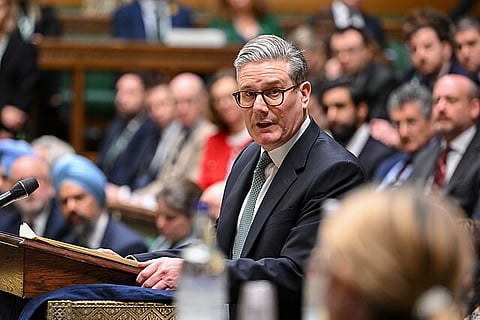


For the second time in as many months, Keir Starmer finds himself fighting for political survival. On Friday, a visibly angry prime minister told reporters in Paris that it was “unforgivable” and “staggering” that he had not been informed his hand‑picked ambassador to Washington, Peter Mandelson, had failed security vetting before taking up the post. “That I wasn’t told that Peter Mandelson had failed security vetting when he was appointed is staggering,” Starmer said. “That I wasn’t told that he had failed security vetting when I was telling Parliament that due process had been followed is unforgivable.” “Not only was I not told, no minister was told, and I’m absolutely furious about that,” he added. The problem, however, is that Starmer had repeatedly assured Parliament and the public that “full due process” had been followed in Mandelson’s appointment, and that his candidate had passed the necessary security checks. Now it emerges that in January 2025, UK Security Vetting (UKSV) had actually recommended against granting Mandelson the highest level of security clearance. That recommendation was overruled by the Foreign Office, a decision of which Starmer claims he was entirely unaware until this week. For a prime minister who once built his reputation on competence, transparency and the rule of law, the defence of “nobody told me” is beginning to wear painfully thin.
The Mandelson affair has haunted Starmer since December 2024, when he announced the appointment of the veteran Labour fixer as ambassador to the United States. Mandelson took up the post in February 2025 but was sacked just seven months later after a trove of emails revealed the depth of his long‑standing friendship with the late convicted sex offender Jeffrey Epstein. The Epstein connection alone would have been damaging enough. But the latest twist, that Mandelson was appointed despite having failed security vetting has turned a question of poor judgment into a potential constitutional crisis. Worse still, Mandelson is now under police investigation for allegedly leaking sensitive government documents to Epstein while serving as business secretary between 2008 and 2010. In February 2026 he was arrested and released on bail as part of that inquiry, though he has not been charged and denies any wrongdoing. Starmer has previously apologised for the appointment, accusing Mandelson of creating a “litany of deceit” about the extent of his Epstein ties. Yet the prime minister’s attempt to shift the blame onto his former envoy now appears to be unravelling, as the focus moves from Mandelson’s conduct to Starmer’s own knowledge and actions.
The core political charge against Starmer is that he knowingly misled Parliament. During Prime Minister’s Questions on 10 September 2025, he told MPs three times that “full due process” had been followed in Mandelson’s appointment. The Ministerial Code is unambiguous: ministers who knowingly mislead Parliament are expected to resign. Starmer’s allies argue that the prime minister was genuinely unaware of the failed vetting, and that his statements were therefore made in good faith. But critics are unimpressed. Conservative leader Kemi Badenoch told the BBC that Starmer had shown “deliberate dishonesty” and that “it is resignation time”. “The prime minister appointed Peter Mandelson before the vetting had been completed, vetting Mandelson failed. Starmer then said full due process was followed. That is misleading Parliament,” Badenoch said. The Liberal Democrat leader, Ed Davey, has also called on Starmer to step down, arguing that even if the prime minister was unaware, he should have come clean at the earliest opportunity rather than waiting for the media to force the truth out. The SNP’s Westminster leader, Stephen Flynn, delivered an even more blistering verdict: “The prime minister is either incompetent, gullible or a liar. Or all three.”
Determined to contain the damage, Starmer moved swiftly on Thursday evening to sack the most senior official at the Foreign Office, Sir Olly Robbins. The BBC understands that both Starmer and Foreign Secretary Yvette Cooper lost confidence in Robbins, who had been in the role for just two weeks when the vetting decision was made. According to a government spokesperson, neither the prime minister nor any other minister was aware that Mandelson had been granted developed vetting against the advice of UK Security Vetting until earlier this week. Robbins’s departure is being presented as the accountability of a senior civil servant who failed to inform his political masters. But critics see it differently: a convenient sacrifice to protect a prime minister who has run out of excuses. One Labour backbencher told the Guardian that “it simply doesn’t sound credible for Keir Starmer to claim that he was unaware that Mandelson had been denied security clearance”. Another Labour MP quoted by the newspaper said the prime minister had painted himself as “whiter than white” but now looked increasingly vulnerable. “I can’t see how he survives this,” the MP said. The very fact that Starmer has been forced to sack his most senior diplomat and will now face a humiliating statement to Parliament on Monday suggests that No 10 is in full damage‑control mode.
The timing could hardly be worse for the prime minister. Local elections in England, alongside regional votes in Scotland and Wales, are scheduled for 7 May, and Labour is widely expected to suffer heavy losses. The party is bleeding support on its left flank to the Greens, while Nigel Farage’s Reform UK is pulling disillusioned voters from both Labour and the Conservatives. In normal circumstances, a scandal of this magnitude might be enough to force a leadership challenge. However, several Labour MPs told the Guardian that changing leaders in the middle of a war is not an appealing prospect. Since the US‑Israeli attacks on Iran began at the end of February, the United Kingdom has been a semi‑participant in the conflict, however unwillingly, and is braced for severe economic fallout. The war may be buying Starmer time, but it is not buying him loyalty. Meanwhile, Farage, whose Reform party is now polling ahead of Labour in some surveys has joined the chorus calling for Starmer to go. With the prime minister due to address Parliament on Monday and expected to face a barrage of hostile questions, the coming days could determine whether he can limp on or whether his premiership has finally reached its end.