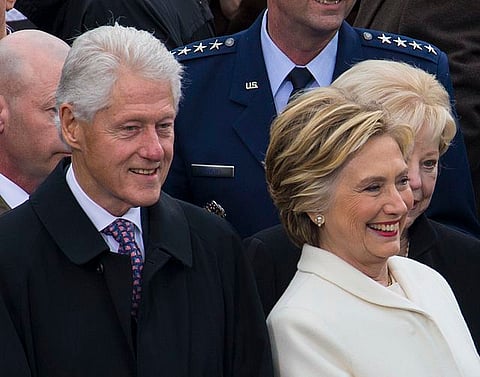


Former President Bill Clinton and former Secretary of State Hillary Clinton have publicly refused to comply with congressional subpoenas to testify in the House investigation into Jeffrey Epstein. The Clintons framed their defiance as a stand against a politically motivated "ploy" directed by President Donald Trump, risking historic contempt of Congress proceedings that could lead to criminal charges.
The Clintons announced their refusal in a pointed public letter addressed to House Oversight Committee Chairman James Comer. They declared that "every person has to decide when they have seen or had enough and are ready to fight for this country," and stated, "for us, now is that time". Their legal team argued the subpoenas were "invalid and legally unenforceable," "untethered to a valid legislative purpose," and an "unprecedented infringement on the separation of powers".
The core of their defense is an accusation of raw political manipulation. They assert the investigation is "nothing more than a ploy to attempt to embarrass political rivals, as President Trump has directed". The Clintons accused Chairman Comer of focusing on them while failing to properly investigate the government's overall handling of the Epstein case, and suggested his actions were designed to distract from the Trump administration's own controversies.
Chairman Comer confirmed that former President Bill Clinton did not appear for his scheduled closed-door deposition on Tuesday, January 13th. In response, Comer announced the committee will meet next week to vote on holding him in contempt of Congress. A committee spokesperson stated that similar proceedings would begin against Hillary Clinton if she fails to appear for her scheduled deposition on Wednesday.
Comer defended the investigation, noting the subpoenas for the Clintons were "voted on in a bipartisan manner by this committee". He emphasized, "No one's accusing Bill Clinton of any wrongdoing. We just have questions," citing the former president's well-documented associations with Epstein, including multiple trips on his private jet. The potential consequences of a contempt charge are significant, though historically uncertain. If convicted of criminal contempt of Congress, an individual can face a fine of up to $100,000 and up to a year in prison.
The committee's interest stems from Bill Clinton's social and philanthropic connections with Epstein in the late 1990s and early 2000s. Public records show Epstein visited the Clinton White House at least 17 times between 1993 and 1994. A Clinton spokesperson has acknowledged the former president took four trips on Epstein's private plane in 2002-2003 for Clinton Foundation work, and had a meeting at Epstein's New York office in 2002.
Bill Clinton has repeatedly stated he had no knowledge of Epstein's crimes and cut off contact well before Epstein's first conviction in 2008. Hillary Clinton's legal team states she "has no personal knowledge of Epstein or Maxwell's criminal activities" and never flew on his aircraft. No survivors of Epstein's abuse have accused either Clinton of wrongdoing.
The confrontation occurs amidst a fraught political climate. President Trump, who also had a well-documented social relationship with Epstein in the 1990s and early 2000s, has recently called for investigations into Epstein's "Democrat friends". Chairman Comer has indicated his committee would not seek to compel testimony from the sitting president, stating it "could not force a sitting president to testify".
Meanwhile, the Trump administration has overseen the release of documents related to Epstein, including recent photographs of Bill Clinton on Epstein's properties, under the Epstein Files Transparency Act passed by Congress. The Clintons and some lawmakers argue the Justice Department has not fully complied with the law's requirements.
The standoff presents a major test of congressional authority and the weaponization of oversight. As the committee moves toward an unprecedented contempt vote against a former president and a former secretary of state, the episode underscores how the long shadow of Jeffrey Epstein continues to fuel political combat at the highest levels of American power.