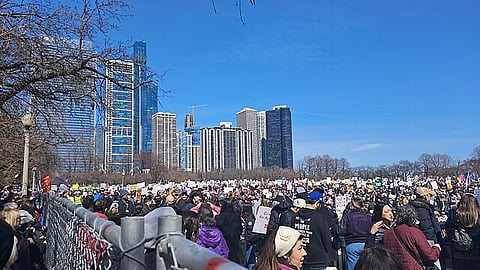


Massive protests against President Donald Trump and his administration's policies erupted across the United States and beyond on Saturday, as millions of Americans took to the streets for the third nationwide "No Kings" day of action. Organizers from grassroots coalitions including Indivisible and MoveOn estimated that more than 9 million people participated in over 3,100 events spanning all 50 states, making it potentially one of the largest coordinated protest movements in American history. The demonstrations, which began in June 2025 and drew an estimated 5 million people, then grew to 7 million in October, have now reached unprecedented scale as opposition to Trump's agenda intensifies.
Protesters carried signs decrying what they characterized as Trump's authoritarian governing style, with slogans such as "No Kings," "Put down the crown, clown," and "Regime change begins at home". The demonstrations have been fueled by multiple flashpoints: the ongoing war against Iran that Trump launched alongside Israel, aggressive federal immigration enforcement that led to the fatal shootings of two US citizens in Minneapolis in January, and what critics describe as the administration's systematic dismantling of democratic institutions and constitutional norms. "Since the last time we marched, this administration has dragged us deeper into war," said Naveed Shah of Common Defense, a veterans association connected to the movement. "At home, we've watched citizens killed in the streets by militarized forces. We've seen families torn apart and immigrant communities targeted. All of it done in the name of one man trying to rule like a king".
Minnesota emerged as the symbolic heart of Saturday's protests, designated by organizers as the "flagship" location in recognition of how the state became ground zero for resistance after federal immigration agents fatally shot Renee Good and Alex Pretti during January protests in Minneapolis. An estimated 100,000 to 150,000 people converged on the Minnesota State Capitol in St. Paul, where rocker Bruce Springsteen performed "Streets of Minneapolis," a protest ballad he wrote and recorded in just 24 hours following the January shootings. "The No Kings movement is of great import right now," Springsteen told the Minnesota Star Tribune ahead of the event. "When you have the opportunity to sing something where the timing is essential and if you have something powerful to sing, it elevates the moment, it elevates your job to another level".
The St. Paul rally featured a powerful lineup of speakers and performers, including Vermont Senator Bernie Sanders, actress and activist Jane Fonda, folk icon Joan Baez, and singer Maggie Rogers. Sanders addressed the crowd on issues of oligarchy and authoritarianism, while Springsteen's performance of "Streets of Minneapolis" included lyrics referencing the January shootings: "Through the winter's ice and cold / Down Nicollet Avenue / A city aflame fought fire and ice / 'Neath an occupier's boots / King Trump's private army from the DHS / Guns belted to their coats / Came to Minneapolis to enforce the law / Or so their story goes". The event also featured speeches from labor leaders, civil rights activists, and families affected by immigration enforcement actions.
Unlike previous protest waves that were concentrated in urban Democratic strongholds, organizers noted a significant surge in participation from rural and suburban areas, with two-thirds of RSVPs coming from outside major metropolitan centers. Demonstrations were reported in conservative-leaning states including Idaho, Wyoming, Montana, Utah, South Dakota, and Louisiana, as well as competitive suburban districts in Pennsylvania, Georgia, and Arizona. In Florida, protests took place in more than 100 locations across the state, including one event just four miles from Trump's Mar-a-Lago estate, where the president was reportedly spending the weekend. In Covington, Kentucky, more than 500 people gathered at the base of the John A. Roebling Suspension Bridge. Even in the Alaskan town of Kotzebue, above the Arctic Circle, residents joined the national movement.
The anti-Trump sentiment extended internationally, with rallies held in European cities including Paris, London, Amsterdam, Madrid, and Rome. In Paris, several hundred people, mostly Americans living in France, gathered at the Bastille alongside French labor unions and human rights organizations, holding signs that read "No Kings, No War". Ada Shen, the Paris No Kings organizer, stated, "I protest all of Trump's illegal, immoral, reckless, and feckless, endless wars". In Rome, thousands marched with chants, waving banners protesting the US and Israeli attacks on Iran and calling for "a world free from wars". London protesters held banners reading "Stop the far right" and "Stand up to Racism".
The massive protests occur as Trump's approval rating has sunk below 40 percent, with midterm elections looming in November when Republicans could potentially lose control of both chambers of Congress. Organizers framed Saturday's demonstrations as a critical moment to build momentum for electoral change. Katie Bethell, executive director of MoveOn, told reporters that the massive turnout was meant to "send the loudest, clearest message yet that this country does not belong to kings, dictators, tyrants". The movement has also highlighted the contrast between Trump's campaign promises of peace and his escalation of military conflict, with protesters carrying signs opposing the war in Iran and the administration's broader foreign policy approach.
The White House dismissed the demonstrations, with spokesperson Abigail Jackson describing them as "Trump Derangement Therapy Sessions" and suggesting they had little real public support, stating that "the only people who care about these are the reporters who are paid to cover them". The National Republican Congressional Committee was sharply critical, with spokesperson Maureen O'Toole characterizing the events as "Hate America Rallies where the far-left's most violent, deranged fantasies get a microphone".