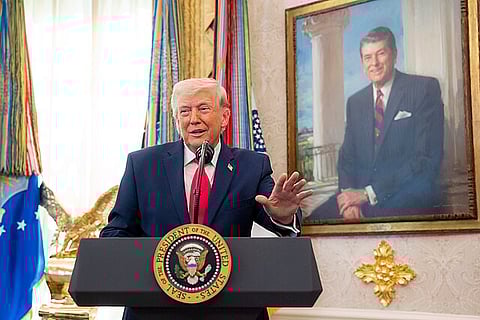


President Donald Trump made history on Wednesday by becoming the first sitting president to attend oral arguments at the Supreme Court, witnessing firsthand as a majority of justices across the ideological spectrum expressed deep skepticism toward his executive order seeking to end birthright citizenship for children born in the United States to noncitizen parents. The Republican president, wearing a dark suit and red tie, sat in the front row of the public gallery as his administration's top Supreme Court lawyer, Solicitor General D. John Sauer, faced more than two hours of rigorous questioning from both liberal and conservative justices about the legality of the directive, which has been blocked by lower courts since its signing on the first day of Trump's second term. Trump departed midway through the proceedings, shortly after Sauer concluded his presentation and before the attorney for the challengers began her argument.
The case centers on the meaning of the 14th Amendment's Citizenship Clause, ratified in 1868 to overturn the infamous Dred Scott decision that had denied citizenship to Black Americans. The provision states that "all persons born or naturalized in the United States, and subject to the jurisdiction thereof, are citizens of the United States". For more than a century, this clause has been understood to grant automatic citizenship to nearly all children born on U.S. soil, with only narrow exceptions such as the children of foreign diplomats or members of an invading hostile force. Trump's executive order seeks to dramatically narrow that interpretation, asserting that the phrase "subject to the jurisdiction thereof" excludes children born to parents who are in the country illegally or on temporary visas, including students, tourists, and workers.
Chief Justice John Roberts, a conservative appointed by President George W. Bush, was among the first to voice skepticism, characterizing the administration's legal foundation as resting on "tiny and sort of idiosyncratic examples" that could not plausibly extend to the millions of people affected by the order. Roberts noted that the historical exceptions cited by the government; children of ambassadors, children born to enemy forces during hostile invasion, and children born on foreign warships, provided no clear path to excluding the children of undocumented immigrants. "I'm not quite sure how you can get to that big group from such tiny and sort of idiosyncratic examples," Roberts told Sauer.
Justice Elena Kagan, a liberal appointee, pressed Sauer on the lack of textual support for his position, telling him that the administration appeared to be "looking for some more technical, esoteric meaning" rather than accepting the plain language of the 14th Amendment. Kagan questioned where the administration's emphasis on concepts like "allegiance" and "domicile" derived from, noting that "the text of the clause does not support you". Justice Neil Gorsuch, a Trump appointee, also challenged Sauer's historical sources, pointing out that some of the administration's citations dated back to Roman law and questioning how such obscure references could justify reinterpreting a constitutional provision. Gorsuch further pressed Sauer on how the government would practically determine a newborn's citizenship status, asking whose domicile would matter and whether every birth would require government verification.
Justice Amy Coney Barrett, another Trump appointee, raised a pointed question about the historical context of the 14th Amendment's ratification. She noted that enslaved people and their children were brought to the United States illegally under laws that forbade the slave trade, asking Sauer how that fact squared with his argument that modern undocumented immigrants should be excluded from birthright citizenship because they entered unlawfully. Sauer responded that once enslaved people were in the United States, they had no allegiance to any foreign entity and were lawfully domiciled, a distinction that several justices appeared to find unconvincing.
Justice Samuel Alito, a conservative appointee, was the only justice who appeared to lean in favor of the administration's position, suggesting that the exceptions to the 14th Amendment could be expanded to account for "something that was unknown at the time; illegal immigration". However, even Alito's questions revealed the conceptual difficulties of the government's case, as he struggled to articulate a clear rule for determining which children would qualify for citizenship and which would not. Justice Ketanji Brown Jackson pressed Sauer on the practical implications, asking whether the government intended to verify the immigration status of every mother giving birth in the United States.
The challengers, represented by American Civil Liberties Union attorney Cecillia Wang, argued that the 14th Amendment established a "fixed bright-line rule" for citizenship that has served the nation well for over 150 years. Wang told the justices that "ask any American what our citizenship rule is and they will tell you, 'Everyone born here is a citizen, alike'". She emphasized that the 14th Amendment was intended to put citizenship "out of the reach of any government official to destroy". Wang also invoked the Supreme Court's 1898 decision in United States v. Wong Kim Ark, which held that a man born in San Francisco to Chinese immigrant parents was a U.S. citizen. That decision has long been understood as affirming the broad application of birthright citizenship, and both sides in the current case claimed it supported their position.
Justice Brett Kavanaugh, a Trump appointee, suggested a potential path that would allow the court to rule against the administration without reaching the constitutional question. Noting that the Immigration and Nationality Act of 1952 codified birthright citizenship in language nearly identical to the 14th Amendment, Kavanaugh asked whether the court could simply rule that the statute, rather than the Constitution, prohibits Trump's order. Sauer acknowledged that if the court ruled on statutory grounds, the administration would lose, and Wang indicated she would be "happy to win on either" basis. Such a ruling would leave the constitutional question unresolved for a future case.
Outside the courthouse, hundreds of demonstrators gathered in support of birthright citizenship, with many holding signs reading "Protect the 14th Amendment" and "We Are All Americans". Among the crowd were birthright citizens themselves, including first-generation Mexican-American Stephanie Sanchez, who told reporters that "without birthright citizenship I wouldn't even have my citizenship in the United States". The scene underscored the high stakes of the case, which could affect an estimated 250,000 to 280,000 babies born in the United States each year. Opponents of the order argue that if upheld, it would create a "undocumented underclass" of children with limited access to education, health care, and social services, potentially leaving some stateless.
Trump's attendance at the arguments drew sharp reactions from legal experts and court observers. University of Michigan law professor Margo Schlanger called it "extremely rare" for a president to challenge longstanding constitutional precedent, while Georgetown law professor Michele Goodwin noted that while other presidents have issued executive orders restricting rights, "it has never happened that a president has gone after a particular amendment itself". The president's presence in the courtroom, seated among the public gallery rather than at counsel table, was seen by some as an attempt to pressure the justices as they consider a case that will define his second-term legacy. A decision in Trump v. Barbara is expected by late June or early July.