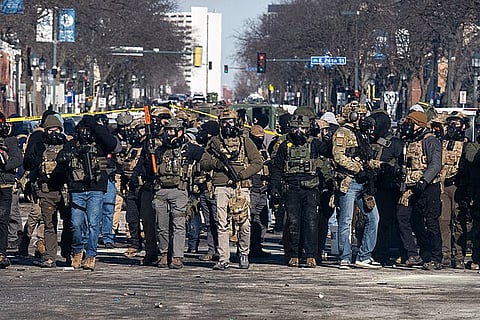


As bystander video contradicted official accounts of federal agents fatally shooting two American citizens in Minneapolis this month, a deliberate pattern has emerged: the Trump administration systematically opposed accountability measures for its aggressive immigration enforcement while dramatically scaling back oversight, creating a system with minimal transparency and weakened checks on its power.
The administration actively moved to curb the expansion of body-worn cameras for Immigration and Customs Enforcement officers, even as those cameras are widely viewed as essential tools for police accountability. According to Darius Reeves, the former director of ICE's Baltimore field office, a body camera pilot program that had been slow under President Biden "died on the vine" under Trump. The administration urged Congress to slash the program's funding by 75% and, in its 2026 budget request, proposed cutting the program's staff from 22 employees to just three. While the Republican-led House recently approved $20 million for ICE and Border Patrol cameras, the bill notably does not require the agencies to actually use them.
This policy choice has taken on deadly significance. When Border Patrol agents shot and killed ICU nurse Alex Pretti on January 24, and when an ICE agent shot and killed Renee Good on January 7, officials quickly labeled the deceased as aggressors. White House Deputy Chief of Staff Stephen Miller called Pretti a "domestic terrorist" and "would-be assassin" hours after the shooting. However, bystander footage has been critical in challenging these official narratives. At Pretti's shooting, Reuters verified that at least three of the eight or more agents present were wearing body cameras, but it is unknown if they were activated.
Concurrently, the administration severely undermined internal oversight. In early 2025, nearly 300 employees across three internal DHS watchdog offices, including the Office of the Immigration Detention Ombudsman (OIDO), were placed on paid leave. The staff of the OIDO, which handles abuse complaints from detention facilities, plummeted from over a hundred in March 2025 to just three full-time employees and two detailees by December. The office, which received over 11,000 in-person complaints in 2023, received only 285 total complaints from March through December 2025, indicating the decimated office could not function. A lawsuit argues the administration effectively eliminated these offices, leaving "no way to address abuses".
The administration also attempted to obstruct external oversight. A federal court recently issued a temporary order stopping a policy that blocked Members of Congress from making unannounced visits to immigration detention facilities. A dozen House members had sued, arguing the administration violated a law guaranteeing congressional oversight. "No president can hide the truth about how people are treated in federal immigration custody," said Skye Perryman of Democracy Forward, which represented the lawmakers.
These transparency and accountability rollbacks have occurred against the backdrop of "Operation Metro Surge" in Minneapolis, which the Department of Homeland Security calls its largest operation ever. The agency has surged thousands of agents into the city, outnumbering local police by more than five to one. This massive, aggressive presence has sparked continuous protests, with nearly 30% of demonstrations in Minnesota involving physical confrontations, the highest rate recorded for any major ICE operation.
The operation's tactics have drawn widespread criticism. Former U.S. Customs and Border Protection Commissioner Gil Kerlikowske told NPR that agents appear "totally unprepared" for urban policing, using tear gas and pepper balls in ways that violate standard practices. Legal experts and advocates note that federal agents, many from agencies like the Border Patrol or Federal Bureau of Prisons with no background in complex immigration law, are conducting street-level enforcement and questioning people, including U.S. citizens, often based solely on their appearance. The ACLU has filed a lawsuit alleging racial profiling and unlawful arrests in Minnesota.
Public outrage escalated further after images circulated of five-year-old Liam Conejo Ramos, an asylum seeker, being detained by ICE agents. His teacher called him "a bright young student," and his detention sparked thousands to protest in freezing temperatures, with hundreds of businesses closing in solidarity. Vice President JD Vance defended the child's detention, arguing agents were protecting him after his father fled.
The administration frames these sweeping operations as a necessary response to sanctuary city policies and a fulfillment of a public mandate. DHS claims 70% of those arrested by ICE have criminal records and credits the crackdown with safer communities and historic lows in border apprehensions. However, data from the University of California Berkeley indicates that in the first nine months of Trump's term, about 75,000 people arrested by ICE, over a third had no criminal record.
As the operations continue, the consequences of reducing transparency and oversight are becoming starkly clear. With internal watchdogs neutered, body cameras scarce, and congressional oversight challenged, the administration has created an enforcement regime where accountability largely depends on the smartphones of bystanders and the courage of protesters.