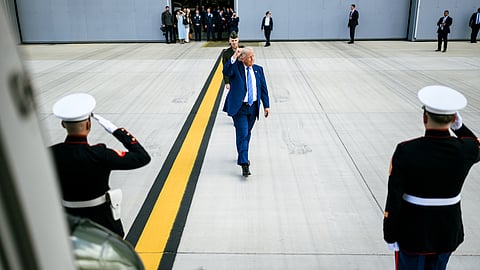


The Trump administration has issued subpoenas to four New York Times journalists following their reporting on security concerns involving President Donald Trump's new Air Force One aircraft, prompting criticism from press freedom advocates and lawmakers.
The newspaper said federal agents delivered some of the subpoenas to reporters' homes, requiring them to testify before a federal grand jury in Manhattan on Wednesday as part of an investigation into an alleged violation of federal criminal law.
The Justice Department said it was investigating illegal leaks rather than targeting journalists, while The New York Times argued the action represented an attempt to intimidate the press and discourage reporting on matters of public interest.
The subpoenas relate to reporting published after Trump's return from the 2026 NATO summit in Ankara, Türkiye.
The New York Times reported that Trump switched from the new Air Force One, a Boeing 747-8 donated by Qatar and modified by the US military, to the older presidential aircraft for his return flight after advice from the Secret Service.
A follow-up report cited anonymous sources who said the newer aircraft lacked some advanced security capabilities, including antimissile protections, because there had not been enough time to complete all required upgrades.
Before publication, the newspaper said a senior FBI official requested that it delay its reporting and reveal its confidential sources, a request the newspaper declined.
The Justice Department maintained that "Reporters are not the targets, those leaking classified information are."
The subpoenas were authorized by Jay Clayton, the US attorney for the Southern District of New York.
The New York Times said the subpoenas were issued to Eric Schmitt, Tyler Pager, Eric Lipton and Julian E. Barnes.
Press freedom organizations, including the Committee to Protect Journalists, condemned the move, describing it as an escalation in pressure on independent media.
The development adds to a series of legal disputes between the Trump administration and major news organizations, including lawsuits involving The New York Times, the BBC and The Wall Street Journal, as well as actions against individual journalists.
The administration has denied seeking to undermine press freedom, arguing that protecting classified information and national security remains its priority.