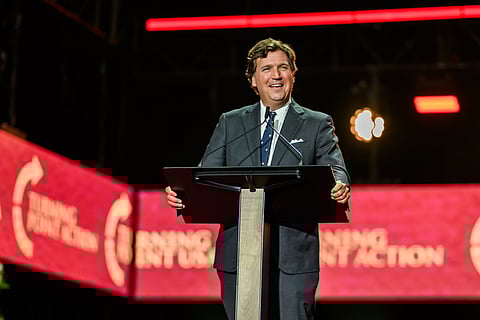


US President Donald Trump has publicly distanced himself from conservative commentator Tucker Carlson, declaring that the former Fox News host is no longer part of the Make America Great Again movement. The break highlights growing tensions inside the political coalition that helped return Trump to power.
In an interview with ABC News on Thursday, Trump said Carlson had “lost his way,” arguing that the commentator no longer represents the priorities of the movement. According to the president, MAGA remains centered on an America First agenda focused on domestic renewal and national strength. In Trump’s words, the movement is about “saving our country” and “making our country great again,” goals he suggested Carlson no longer supports.
The dispute appears to have crystallized following the recent US and Israeli strikes on Iran, a development that has revived long-standing debates inside conservative politics about the role of American power abroad.
Carlson has strongly criticized the military action. On his online platform, the Tucker Carlson Network, he described the attack as “absolutely disgusting and evil,” placing him in direct opposition to the administration’s stance.
During the 2024 presidential campaign, Trump repeatedly promised to reduce American involvement in foreign conflicts. He framed himself as a “peace president,” arguing that Washington should focus on ending wars rather than starting new ones. That message became one of the central themes of the campaign and resonated with many voters skeptical of prolonged foreign interventions.
Carlson has increasingly positioned himself as one of the most prominent advocates of a non-interventionist conservative foreign policy. Since leaving Fox News, he has built a large independent media platform that frequently challenges traditional Republican thinking on alliances, military deployments, and global strategy.
The disagreement over Iran reflects a deeper tension inside the broader MAGA coalition, where competing interpretations of “America First” continue to shape debate about how the United States should engage with the world.
Carlson was once closely aligned with Trump’s political rise. He spoke at the Republican National Convention in 2024 and conducted a widely viewed interview with Trump during the election campaign.
Since then, he has developed a more independent position within conservative media. His interviews with international figures, including Russian President Vladimir Putin and Russian Foreign Minister Sergey Lavrov in Moscow, drew global attention and considerable controversy in the United States. Some of his content has also been broadcast by the Russian state outlet RT.
Trump’s frustration with Carlson had surfaced earlier. In June of last year, the president called the commentator “kooky” on Truth Social after Carlson criticized voices calling for military action against Iran.
The dispute with Carlson comes as other internal divisions have emerged within Trump’s political orbit. One of the most visible involves former Republican congresswoman Marjorie Taylor Greene, who had long been one of Trump’s strongest allies in Congress.
Relations between the two deteriorated after disagreements over the release of documents connected to the late financier Jeffrey Epstein. Greene accused Trump of blocking the disclosure of the files and demanded greater transparency. Trump responded with public attacks, calling her “wacky” and a “ranting lunatic.”
The conflict deepened following the US strikes on Iran. Greene accused the administration of betraying Trump’s earlier pledge to avoid new wars and questioned the president’s judgment in authorizing the operation.
Taken together, these disputes suggest a broader transition within the movement that has defined Republican politics in recent years. As international crises intensify and policy choices sharpen ideological lines, the coalition built around the slogan “America First” is increasingly debating what that principle should mean in practice.