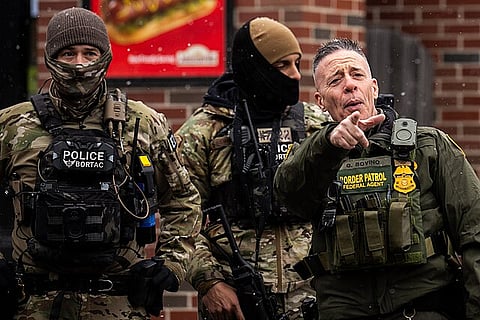


The Trump administration has quietly but dramatically expanded the authority of Immigration and Customs Enforcement to detain lawfully admitted refugees who are awaiting green cards, implementing a new policy that refugee advocacy groups are condemning as a dangerous breach of faith with some of the world's most vulnerable populations. The directive, issued in a joint memorandum dated February 18, 2026, and signed by acting ICE Director Todd Lyons and USCIS Director Joseph Edlow, requires refugees who have not obtained lawful permanent resident status within one year of their arrival to return to government custody for "inspection and examination". If they fail to appear voluntarily, the memo authorizes immigration authorities to arrest and detain them for the duration of the re-vetting process. The policy represents a stark reversal of a 2010 memorandum from the Obama era, which explicitly stated that failure to obtain permanent resident status was not a "basis" for removal and not a "proper basis" for detention.
"Reckless Reversal"
The response from organizations that work directly with refugee populations has been swift and deeply critical. Shawn VanDiver, president of AfghanEvac, which has been instrumental in resettling Afghan allies who risked their lives working alongside American troops, called the directive "a reckless reversal of long-standing policy" that "breaks faith with people the United States lawfully admitted and promised protection". The policy lands as ICE detention numbers have surged to approximately 68,000 people this month, a staggering 75 percent increase from when Trump took office last year. Critics note that refugees undergo some of the most rigorous screening of any category of entrant to the United States, including extensive background checks, medical examinations, and interagency security reviews, long before they ever set foot on American soil.
Ruling Against Administration's Mandatory Detention Policy
On the same day the new refugee detention memo was quietly filed in federal court, a separate but equally significant legal blow landed against the administration's broader immigration enforcement agenda. U.S. District Judge Sunshine Sykes in Riverside, California, vacated a decision by the Board of Immigration Appeals that had endorsed the Trump administration's policy of subjecting thousands of people arrested during its immigration crackdown to mandatory detention without the possibility of bond. Judge Sykes, an appointee of former President Joe Biden, did not mince words in her ruling, calling the administration's actions "shameless" and accusing it of continuing its "campaign of illegal action" by refusing to provide bond hearings despite her prior order declaring the underlying policy unlawful. "Respondents have far crossed the boundaries of constitutional conduct," Sykes wrote in a decision that applies nationwide to a class action lawsuit covering migrants across the country.
Legal Strategy and Judicial Independence
The ruling from Judge Sykes carries particular weight because it goes beyond the hundreds of individual decisions by other federal judges who have found the mandatory detention policy unlawful in specific cases. By vacating the Board of Immigration Appeals decision itself, Sykes has stripped immigration judges of the legal foundation they were using to deny bond hearings to thousands of detainees. The case stems from the Department of Homeland Security's aggressive reinterpretation of federal immigration law last year, when it took the position that non-citizens already residing in the United States should be treated as "applicants for admission" and therefore subject to mandatory detention, a reading that bucked decades of established interpretation. When the Board of Immigration Appeals adopted that interpretation in September, it triggered a wave of mandatory detention orders nationwide. Chief Immigration Judge Teresa Riley then issued guidance instructing her colleagues that they were not bound by Sykes' earlier December ruling and should continue following the board's decision, a move that prompted Sykes to issue her stronger, vacating order this week.
The Human Toll
The legal clashes unfolding in federal courthouses represent far more than abstract constitutional debates for the thousands of people now caught in the administration's enforcement machinery. Refugees who fled war, persecution, and violence in their home countries, after being screened, vetted, and lawfully admitted to the United States with promises of protection, now face the prospect of arrest and detention simply for navigating the administrative process of adjusting their status. A federal judge in Minnesota temporarily blocked a similar policy in January targeting approximately 5,600 lawful refugees in that state, ruling that federal agents likely violated multiple federal statutes by arresting some of these refugees for additional vetting. Niels Frenzen, a professor at the University of Southern California's Gould School of Law who represented plaintiffs in the bond hearing case, expressed hope that "DHS and the immigration courts will now comply with the court's orders to provide bond hearings to the thousands of noncitizens who have been arrested". The Trump administration, through the Department of Homeland Security and the Department of Justice, has not responded to requests for comment on either the new refugee detention memo or the adverse court ruling.