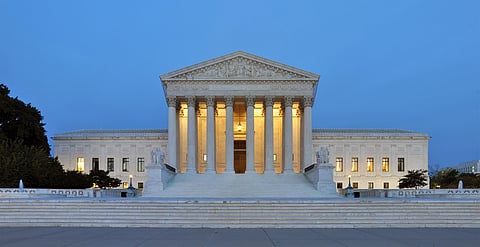


The United States Supreme Court has ruled 6-3 against President Donald Trump's executive order seeking to end automatic birthright citizenship for children born in the United States to parents without permanent legal status.
The decision marks a significant setback for Trump's immigration agenda and leaves intact the longstanding constitutional interpretation that nearly all children born on US soil are citizens at birth.
The ruling upheld lower court findings that the executive order conflicted with the 14th Amendment and reaffirmed decades of legal precedent.
Writing for the majority, Chief Justice John Roberts traced the history of birthright citizenship from English common law through the adoption of the 14th Amendment in 1868 and the Supreme Court's 1898 decision in United States v Wong Kim Ark.
Roberts concluded that the administration and dissenting justices had not presented sufficient evidence to support a reinterpretation of established constitutional law.
He wrote, "We keep that promise today."
Roberts was joined by Justices Amy Coney Barrett, Brett Kavanaugh, Sonia Sotomayor, Elena Kagan and Ketanji Brown Jackson.
Jackson wrote separately that the universal language of the 14th Amendment reflected principles already central to the nation's identity.
Kavanaugh agreed with the outcome but stated separately that he believed the executive order conflicted with federal law rather than the Constitution.
Trump described the ruling as "too bad" and urged Congress to pursue legislation restricting birthright citizenship, arguing lawmakers should act instead of seeking a constitutional amendment.
The administration had argued that the 14th Amendment applied only to children whose parents were US citizens or permanent residents and that the phrase "subject to the jurisdiction thereof" excluded undocumented immigrants and some temporary visitors.
Justices Clarence Thomas, Samuel Alito and Neil Gorsuch dissented, arguing the majority had misinterpreted the original meaning of the amendment.
Civil rights organizations welcomed the decision, with the American Civil Liberties Union saying it reaffirmed the constitutional guarantee of birthright citizenship.
A study cited during the case warned that implementing the executive order could have left an estimated 255,000 children born each year without citizenship and contributed to the growth of a multigenerational undocumented population.