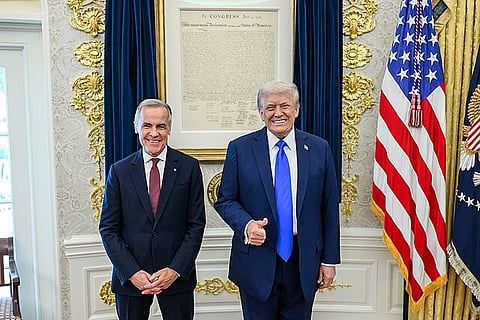


In a public display of discord between historic allies, U.S. President Donald Trump rescinded Canada's invitation to join his newly formed "Board of Peace," directly retaliating for Prime Minister Mark Carney's critique of American power at the World Economic Forum. The move highlights the board's controversial nature and the growing international skepticism surrounding its purpose and structure, with many questioning its legitimacy as a vehicle for genuine conflict resolution.
The immediate catalyst was a speech by Prime Minister Carney in Davos, where he described a global "rupture" and warned that middle powers must band together to avoid being victimized by coercion from larger nations. While not naming the U.S. directly, his remarks on economic intimidation and support for Greenland's sovereignty were widely seen as a rebuke to Trump's policies. Trump responded by stating "Canada lives because of the United States" and should be more grateful. Hours later, he withdrew the Board of Peace invitation via social media.
Conceived as part of a Gaza ceasefire plan endorsed by a UN Security Council resolution, the Board of Peace is envisioned to oversee Gaza's reconstruction and transition. However, its charter, which does not mention Gaza, grants it a broad mandate to address global conflicts, positioning it as a potential rival to UN mechanisms. The board's structure is highly centralized, with Trump as permanent chairman with sole power to designate his successor. A distinctive and contentious feature is a $1 billion fee for nations seeking permanent membership.
The board faces significant international doubt. Key U.S. allies like Britain, France, and Italy have declined to join. Critics, including legal and human rights organizations, argue it undermines Palestinian self-determination and international law by imposing external control. Analysts describe it as a "privatised UN" that makes global diplomacy transactional and serves an "America-first" agenda. Within Canada, human rights advocates welcomed the disinvitation, stating the board makes a "mockery of Palestinian self-determination".
The withdrawal of Canada's invitation exposes the fundamental tensions at the heart of the Board of Peace. It is viewed by supporters as a pragmatic new tool for global problem-solving but is regarded by many other nations and rights groups as an instrument of American unilateralism that risks sidelining established international institutions and the principles they are meant to uphold.