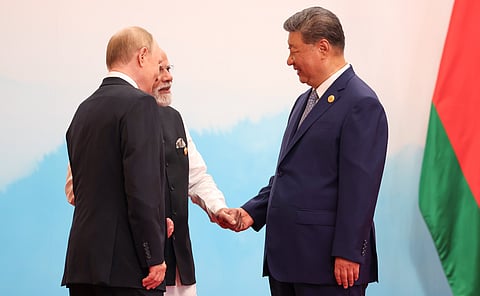


The administration of U.S. President Donald Trump had originally proposed replacing the G-7 with a new international grouping in an earlier, unpublished draft of the U.S. National Security Strategy released last week. According to U.S. media, the draft envisioned the creation of a “Core-5,” or “C5,” as a new forum for global economic and security coordination.
The proposed group would include the United States, Russia, China, India and Japan—five major powers positioned to shape global affairs in what the administration described as a new geopolitical era. The concept was reportedly discussed within the White House as either an alternative to, or outright replacement for, the G-7, which Trump officials increasingly view as outdated.
Notably absent from the C5 were any European countries, a clear reflection of the administration’s growing belief that the post-World War II transatlantic framework is obsolete. The finished National Security Strategy that was published last week sharply criticized Europe, questioned the reliability of the alliance, and even accused European governments of trying to push Washington into conflict with Russia.
While the C5 proposal did not appear in the final draft, its mere inclusion in earlier versions underscores the extent to which the Trump administration is seeking to distance itself from Europe and reorient U.S. foreign policy toward a multipolar system defined by great-power competition rather than traditional alliances.
Variations of a “core powers” framework have been raised in the past, particularly regarding the structure of the UN Security Council. Critics argue that the current council is outdated, with Britain and France retaining permanent seats despite their diminished global influence since 1945, while major rising powers such as India remain excluded. India has actively lobbied for Security Council reform in recent years as part of a broader push to reflect contemporary power realities.
While the U.S., Russia, China, and India are widely seen as the four dominant global powers, the inclusion of Japan as a hypothetical fifth member raises questions due to its strained relations with China and its close alignment with Washington. Some analysts argue that Brazil—a large, resource-rich nation often pursuing a non-aligned foreign policy—would be a stronger candidate for any future global governance framework.