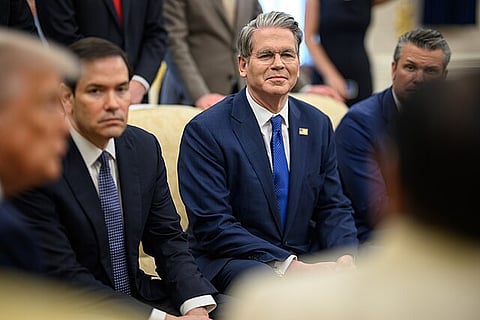


At the World Economic Forum in Davos, U.S. Treasury Secretary Scott Bessent urged European allies to "sit back, relax" and "calm down the hysteria" over President Donald Trump's threat to impose sweeping tariffs on eight NATO countries, a punitive measure linked directly to their opposition to a U.S. takeover of Greenland. This dismissive stance, framing the profound geopolitical crisis as mere noise, has been met with unified European defiance and deepening alarm, testing the foundational alliances of the post-war world and exposing the raw human anxiety of the 57,000 people whose homeland is being treated as a transactional prize.
The immediate catalyst for the crisis is an unprecedented economic threat. President Trump has declared he will "100%" follow through on imposing a 10% tariff on all goods from the United Kingdom, Denmark, Norway, Sweden, France, Germany, the Netherlands, and Finland starting February 1, escalating to 25% by June. The stated condition for lifting these tariffs is a "deal" for Washington to purchase Greenland from Denmark. Secretary Bessent defended the move, arguing it was a "strategic decision" to use America's economic might to "avoid a hot war," controversially claiming "the national emergency is avoiding a national emergency". He further insisted that controlling Greenland is "essential" for Trump's "Golden Dome" missile defense plan, asserting that U.S. ownership is the only way to prevent the country from being drawn into a future conflict over the territory.
The response from Europe has been one of unequivocal rejection and preparation for a fierce response. European Commission President Ursula von der Leyen labeled the tariff threat a "mistake" that risks plunging transatlantic relations into a "downward spiral," and stressed that in politics, "a deal is a deal". She vowed the EU's response would be "unflinching, united and proportional". European leaders are actively preparing countermeasures, including potential retaliatory tariffs on $108 billion of U.S. imports, suspending the recent U.S.-EU trade deal, and, significantly, the first-ever deployment of the EU's "Anti-Coercion Instrument"—a powerful tool unofficially dubbed the "trade bazooka". French President Emmanuel Macron called the threats "fundamentally unacceptable," while British Prime Minister Keir Starmer stated applying tariffs on allies for upholding collective security is "completely wrong".
At the heart of the storm, the people and government of Greenland have repeatedly and forcefully asserted their sovereignty and their trauma. Prime Minister Jens-Frederik Nielsen stated plainly, "Greenland is not for sale" and that international law is "not a game". The local government is now preparing for worst-case scenarios, forming a task force and advising citizens to stockpile five days of food due to the threat of a possible U.S. invasion. Naaja Nathanielsen, Greenland's Minister for Business, described the situation as "devastating," stating her people feel "bewildered" and "afraid" at being discussed "like a product or a property". This sentiment has fueled mass protests in Nuuk and Copenhagen, where demonstrators carried signs reading "Greenland is not for sale" and wore parody red caps that read "Make America Go Away".
The U.S. justification for the takeover is based on national security claims about Greenland's strategic Arctic location. However, critics and experts note the U.S. already operates the Pituffik Space Base in Greenland under a 1951 defense agreement with Denmark that grants extensive access. Furthermore, Trump's claim that there are "no written documents" supporting Danish sovereignty has been thoroughly debunked; multiple international treaties and agreements across the 20th century, including several signed by the United States itself, explicitly recognize Denmark's sovereignty over Greenland. The crisis has sparked grave concerns about the future of NATO, with Danish Prime Minister Mette Frederiksen warning that U.S. military action against Greenland "would spell the end of Nato". Former NATO Secretary General Anders Fogh Rasmussen warned that "the future of NATO is at stake," arguing that the time for appeasing Trump is over and Europe must demonstrate unity and strength.
As President Trump heads to Davos for planned talks, the chasm between the U.S. position and the rest of its allies has never been wider. The dispute transcends a bizarre real estate proposition; it has become a fundamental test of whether the Western alliance is built on mutual respect and international law or on economic coercion and the whims of power. For the resilient people of Greenland, the principle is simple and non-negotiable: their land, their identity, and their future are not commodities to be bought, sold, or conquered.