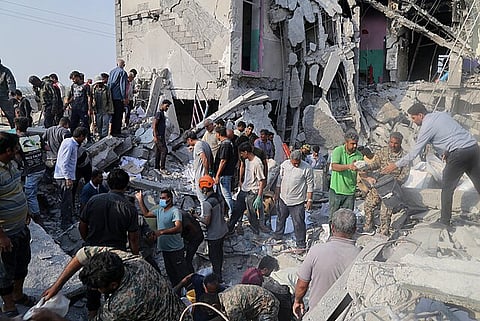


An exhaustive investigation by Amnesty International has determined that the United States bears direct responsibility for the devastating February 28 airstrike on the Shajareh Tayyebeh Elementary School in Minab, southern Iran, which killed approximately 168 people, the vast majority of them children. The human rights organization's findings, based on extensive analysis of satellite imagery, video footage, and interviews with independent sources, constitute the most comprehensive accounting to date of what has become the deadliest single civilian incident of the US-Israeli war on Iran. Amnesty's report concludes that the US violated international humanitarian law by failing to take all feasible precautions to avoid civilian harm, and has demanded a transparent investigation and full accountability for those responsible.
The strike occurred on the morning of February 28, approximately one hour into the coordinated US-Israeli military operation against Iran. According to the governor of Hormozgan province, the missile struck the school at 10:45 a.m. local time. Satellite imagery captured just 22 minutes earlier, at 10:23 a.m., shows the school building still standing intact, while images from March 4 reveal the western half of the structure completely destroyed, reduced to a massive pile of rubble. The attack killed at least 110 school children, 66 boys and 54 girls along with 26 teachers and four parents who had arrived at the school to collect their children. On March 7, Iranian authorities published a collage containing the images of 119 children killed, a visual testament to the scale of the horror.
Amnesty International's investigation included interviews with Sohrab, a Minab resident, and Shiva Amelirad, the international representative of the Coordinating Council of Iranian Teachers' Trade Associations, who relayed harrowing details from independent sources. School staff had begun contacting parents around 10:00 a.m., urging them to pick up their children, a decision that preceded the official nationwide school closure announcement by approximately fifteen minutes. Sohrab described the fatal consequences of timing and distance: "People from nearby streets and those who had time rushed over and tried to take children whose families hadn't arrived yet. Many students were from surrounding villages, and travel took time; those who lived further away faced long delays for a car to come from the village. That delay was fatal. The principals and teachers stayed to get the children out. Most of them were killed".
Amnesty International's Evidence Lab conducted meticulous forensic analysis of more than 30 satellite images, 28 videos, and 30 photographs, as well as studying missile remnants published by Iranian state media. The investigation concluded that a US-manufactured Tomahawk missile was "likely used for the attack". The organization emphasized that Tomahawk missiles are used "exclusively by US forces in this conflict and are precision-guided missiles". The school was directly struck as part of a broader attack on 12 other structures in an adjacent compound belonging to the Islamic Revolutionary Guard Corps (IRGC) Navy's Seyyed al-Shohada Asif Missile Brigade.
The investigation identified a critical failure in US targeting procedures: the school building had been physically separated from the IRGC compound since at least 2016, with boundary walls and three separate gated entrances constructed. Satellite imagery from 2017 and 2018 shows the grounds and walls painted with features and colors resembling other schools in the area, and images captured between 2023 and 2025 on school days show people present outside the entrances. This history, combined with the failure to recognize its current status, "raises concerns that US forces may have relied on outdated intelligence and failed in their obligation to do everything feasible to verify that the intended target was a military objective".
The New York Times reported on March 11 that a preliminary investigation by the US military had found the strike resulted from reliance on outdated data. Further compounding concerns, US Central Command (CENTCOM) Commander Brad Cooper confirmed on March 11 that the United States was using advanced artificial intelligence tools to process large amounts of data related to military operations in Iran. Amnesty International has called for any investigation to examine "how artificial intelligence may have been employed" in targeting decisions, and stressed that "parties to the conflict must ensure that meaningful human control was maintained".
Erika Guevara-Rosas, Amnesty International's Senior Director of Research, Advocacy, Policy and Campaigns, delivered a forceful condemnation of the attack. "This harrowing attack on a school, with classrooms full of children, is a sickening illustration of the catastrophic and entirely predictable price civilians are paying during this armed conflict," she stated. "Schools must be places of safety and learning for children. Instead, this school in Minab became a site of mass killing. The US authorities could, and should, have known it was a school building. Targeting a protected civilian object, such as a school, is strictly prohibited under international humanitarian law".
Amnesty outlined two possible scenarios, both of which would constitute serious violations. If US forces "failed to identify the building as a school and nevertheless proceeded with the attack, this would indicate gross negligence in the planning of the attack and would point to a shameful intelligence failure on the part of the US military and a serious violation of international humanitarian law". Alternatively, if the US "was aware that the school was adjacent to the IRGC compound and proceeded to attack without taking all feasible precautions, such as striking at night when the school would have been empty, or giving effective advance warning to civilians likely to be affected, this would amount to recklessly launching an indiscriminate attack which killed and injured civilians and must be investigated as a war crime".
The US response to the Minab massacre has been characterized by contradiction and deflection. Defense Secretary Pete Hegseth initially stated that the Pentagon was investigating the incident and insisted that "we do not target civilian targets". However, President Donald Trump offered a different and more troubling narrative, suggesting on March 9 that "the Iran or someone else" might have been responsible for the attack, a claim contradicted by all available evidence. A White House spokesman confirmed on March 10 that investigations were ongoing and that the Department of Defense would release a complete report. Meanwhile, US Defense Secretary Hegseth had earlier made alarming statements that appeared to dismiss international legal obligations, telling reporters on March 2: "No stupid rules of engagement, no nation-building quagmire, no democracy-building exercise, no politically correct wars. We fight to win, and we don't waste time or lives".
Amnesty International has issued a comprehensive set of demands to US authorities. The investigation announced by the US must be "impartial, independent and transparent," and "must consider the intelligence gathering and assessments, targeting decisions and precautions taken, as well as how artificial intelligence may have been employed". "The results of the investigation should be made public," the organization insists. Where sufficient evidence exists, "competent authorities should prosecute any person suspected of criminal responsibility," and "victims and their families have the right to truth and justice and should receive full reparation, including restitution, rehabilitation and compensation". Agnès Callamard, Secretary General of Amnesty International, emphasized the fundamental importance of accountability: "This is why we have international law. To prevent exactly this kind of attack on civilians".