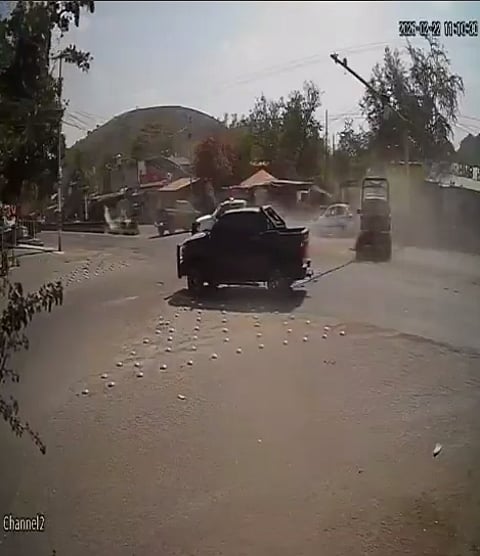


In a major escalation of Mexico's ongoing security crisis, the leader of the powerful Jalisco New Generation Cartel (CJNG), Nemesio Rubén Oseguera Cervantes, known as "El Mencho," has been killed in a military operation in the western state of Jalisco. A government source confirmed the death to Reuters on Sunday, February 22, following an operation in the municipality of Tapalpa. The news triggered an immediate and violent response from the cartel, with gunmen setting up roadblocks and setting vehicles ablaze across Jalisco and neighboring states like Michoacán to impede security forces. In Puerto Vallarta, panic broke out, and Air Canada suspended flights to the city due to the "ongoing security situation". El Mencho, a former police officer, led an organization that grew into a continents-spanning criminal enterprise rivaling the Sinaloa Cartel. He was one of the world's most wanted men, with the U.S. State Department offering a $15 million reward for his capture, and his cartel had been recently designated a Foreign Terrorist Organization by the Trump administration.
The death of El Mencho comes amid a relentless and brutal war between the CJNG and the Sinaloa Cartel for territorial control, a conflict that is devastating vast swaths of the country. Far from a simple battle between two groups, it is a multi-faceted crisis involving internal cartel splits and audacious challenges to state authority. The Sinaloa Cartel itself has been fractured since the July 2024 abduction of its legendary leader, Ismael "El Mayo" Zambada, by a son of Joaquín "El Chapo" Guzmán. His subsequent handover to U.S. authorities ignited a bloody internal war between the "Chapitos" faction loyal to Guzmán's sons and the "Mayos" faction. This infighting has turned the state of Sinaloa into a war zone, with Culiacan experiencing daily shootouts. Official data shows homicides in the state surged by 66% in 2025 compared to the previous year, and forced disappearances have skyrocketed, with nearly 1,500 people still missing.
The territorial ambitions of the cartels have extended the conflict far beyond their home bases. In an audacious show of force in mid-February, a heavily armed convoy of what were reported to be Sinaloa Cartel gunmen drove into the town of Frontera Comalapa in the southern state of Chiapas, near the Guatemalan border. Hundreds of residents lined the streets as the convoy passed, a scene that underscored the cartel's deep entrenchment and its ongoing turf war with the CJNG for control of crucial drug and migrant smuggling routes from Central America. This long-running battle has trapped over 280,000 residents in a state of fear, leading to shortages of food and fuel, and forcing schools to close.
The pervasive violence has cast serious doubt on the security strategy of President Claudia Sheinbaum. In late January, 10 employees of a Canadian-owned mine were abducted in the mountains of Sinaloa. The bodies of five were later found in clandestine graves, with authorities blaming the "Chapitos" faction for mistaking the workers for members of a rival group. This incident, along with the kidnapping of tourists in the resort city of Mazatlán, has "demolished the federal government's narrative" that it is gaining control, according to security analyst David Saucedo. Residents of affected areas report feeling abandoned, with teachers, doctors, and even public transportation disappearing from their communities out of fear.
The cartels are not only fighting each other but are also directly confronting and threatening U.S. authorities. An internal FBI memo obtained by NewsNation revealed that CJNG leadership has ordered its members to shoot at U.S. Border Patrol agents along the border. The directive, circulated among agents in the San Diego Sector, is seen as an attempt by the CJNG to create chaos and seize territory from its rivals. Retired Border Patrol Chief Chris Clem warned that agents across the entire 1,900-mile border need to remain vigilant, as any attack could have severe repercussions. This escalation occurs against a backdrop of heightened U.S. pressure, including the terrorist designation, and ongoing cooperation between the U.S. and Mexico, which recently resulted in the arrest of 1,300 cartel members and the transfer of 55 criminal leaders, including Rafael Caro Quintero, to the United States.