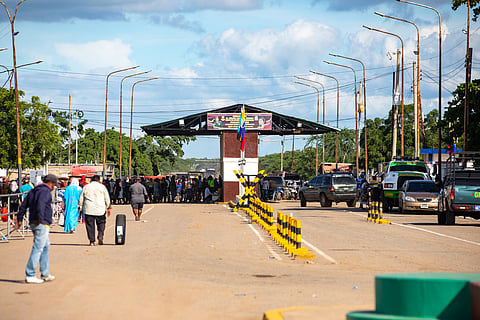


Colombia is confronting simultaneous pressures along its northeastern frontier as officials prepare for a possible influx of Venezuelan refugees while responding to fresh internal displacement caused by rebel fighting.
The developments are unfolding around Cúcuta, a key border city that has become a focal point for both cross-border contingency planning and domestic humanitarian response.
Authorities say the situations are distinct but overlapping in their impact on security resources, aid capacity, and local governance.
So far, officials report no major change in daily border flows, but preparations are being scaled up amid uncertainty.
Colombian officials began reinforcing the border after U.S. strikes in Venezuela and the reported capture of President Nicolás Maduro.
Defense Minister Pedro Sánchez said 30,000 soldiers were deployed to deter potential retaliation from armed groups operating near the frontier.
Security forces have been placed on alert against groups such as the National Liberation Army and the Segunda Marquetalia faction, which have long used Venezuelan territory as a rear base.
Five emergency command posts have been established in border areas to coordinate humanitarian assistance, security, and territorial control.
“These [command posts] allow us to permanently coordinate humanitarian, security and territorial control actions,” Sánchez said.
The government estimates that up to 1.7 million Venezuelans could enter Colombia if conditions deteriorate, adding to the three million already in the country.
Minister of Equality and Equity Juan Carlos Florián said a national border plan is coordinating food, healthcare, and social services with support from international organizations.
Despite the preparations, immigration authorities report that foot traffic, roughly 60,000 people entering and leaving Cúcuta daily, has not increased.
At the same time, Colombia is dealing with renewed internal displacement from fighting in the Catatumbo region.
More than 300 people have fled clashes between rebel groups in the municipalities of Tibú and El Tarra and sought shelter in Cúcuta.
The area has been the scene of long-running conflict involving armed groups competing for control of coca-producing territory.
Human rights officials warned that civilians continue to bear the brunt of the violence and called on armed groups to halt fighting.
Last year, tens of thousands were displaced from Catatumbo, prompting the government to suspend peace talks with the National Liberation Army.
Humanitarian organizations, including the Colombian Red Cross, have activated emergency response plans near the border.
Officials say managing internal displacement while preparing for a potential external refugee wave is placing added pressure on local services.