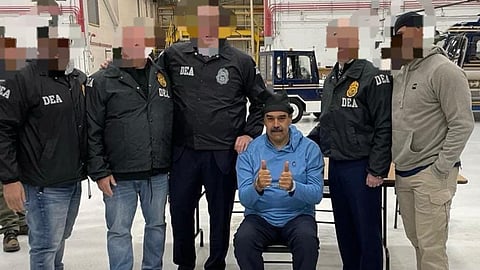


Venezuela’s deposed leader Nicolás Maduro was brought to a New York federal court on Monday to face U.S. drug trafficking charges following a weekend military operation that captured him in Caracas.
The unprecedented move has triggered global debate over legality, sovereignty, and the future of U.S.-Venezuela relations, while leaving political power inside Venezuela largely unchanged.
Maduro and his wife, Cilia Flores, were transported under heavy guard from a Brooklyn detention center to a Manhattan courthouse for a required initial appearance before a judge.
Prosecutors accuse Maduro of overseeing a large-scale cocaine trafficking network that allegedly worked with foreign cartels and armed groups.
The charges carry the potential of life sentences, setting the stage for a prolonged legal fight over jurisdiction and immunity.
Maduro has long denied the allegations, arguing they are politically motivated, and his lawyers are expected to challenge the legality of his arrest.
As a defendant in the U.S. system, he is entitled to the same procedural rights as other accused individuals, including a jury trial.
He is expected to be held at New York’s Metropolitan Detention Center under restrictive conditions while proceedings continue.
Inside Venezuela, senior figures from Maduro’s long-ruling movement remain in control of state institutions, dampening expectations of an immediate political transition.
Acting president Delcy Rodríguez initially condemned the operation but later adopted a conciliatory tone, stating, “We invite the U.S. government to work together on an agenda of cooperation.”
Her remarks contrasted with sharp warnings from President Donald Trump, who has tied future relations to cooperation on drugs and the opening of Venezuela’s oil sector.
International reactions have been divided, with Russia, China, and left-leaning allies condemning the U.S. action, while many Western governments urged restraint and dialogue.
The United Nations Security Council was set to debate the legality and implications of the operation amid broader concern about precedent.
Within Venezuela, uncertainty has led residents to stock up on essentials as markets react to the geopolitical shock.
While investors responded with rising bond prices and modest oil gains, the country’s political future remains unresolved as legal battles and diplomatic maneuvering unfold.