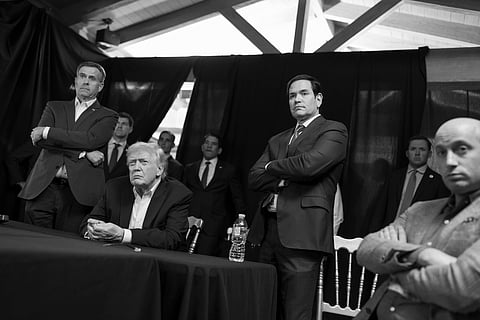


Secretary of State Marco Rubio said Sunday that the United States is directing the course of events in Venezuela following the arrest of President Nicolás Maduro during a U.S. operation early Saturday.
Speaking across multiple television interviews, Rubio said the United States is not governing Venezuela directly but is shaping outcomes through economic and military pressure.
He described the operation as limited in scope and focused on addressing threats tied to drug trafficking, oil revenue, and regional security.
The comments followed President Donald Trump’s statement that Washington would temporarily “run” Venezuela during a transition period, raising questions about U.S. authority and long term intentions.
Rubio emphasized that the administration views the current moment as a turning point rather than an occupation.
Rubio said the central tool being used by the United States is an oil quarantine designed to cut off revenue to the Venezuelan government.
He said the quarantine allows U.S. naval forces, with court authorization, to seize sanctioned vessels entering or leaving Venezuela.
According to Rubio, the objective is to apply pressure until conditions align with U.S. national interests and what he described as the interests of the Venezuelan people.
He said the administration believes Venezuela’s oil industry has benefited senior figures in the government rather than the population.
Rubio added that the United States has significant leverage because the economy depends heavily on oil exports.
He said the quarantine and naval presence would remain in place as Washington evaluates next steps.
Rubio defended the legality of the operation that resulted in Maduro’s arrest, saying congressional approval was not required.
“This is not an invasion,” Rubio said, describing the action as a brief and precise mission.
He said U.S. forces were on the ground for a limited period and are no longer operating inside Venezuela.
Rubio also cited concerns about operational security, arguing that advance congressional notification could have compromised the mission.
Democratic lawmakers criticized the administration for acting without authorization, calling the move unlawful.
Rubio rejected those claims and said Congress would be consulted for any actions that legally require approval.
He said elections in Venezuela are a long term objective but called immediate voting unrealistic.