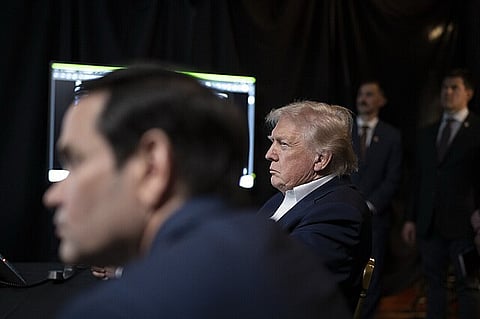


In a stunning declaration of imperial power, United States President Donald Trump has announced that the U.S. will directly "run" Venezuela and deploy its largest oil companies to seize the country's vast energy reserves, following a large-scale military operation that captured President Nicolás Maduro. This overt move to install a client administration and control Venezuela's natural wealth has been condemned worldwide as a brazen violation of international law and a return to the era of gunboat diplomacy.
President Trump explicitly framed the intervention in terms of resource extraction. He stated that "very large United States oil companies" would be sent in to "fix the badly broken infrastructure" and "start making money for the country". While he claimed this would benefit Venezuela, he directly connected it to U.S. military control, vowing to have "a presence in Venezuela as it pertains to oil" and stating that wealth from the ground would also go to the United States "in the form of reimbursement". This confirms long-held accusations from Caracas that Washington's ultimate goal is to commandeer the world's largest proven oil reserves.
The international response has been one of near-universal condemnation, underscoring the operation's illegality. The United Nations Secretary-General was "deeply alarmed," stressing that international law and the UN Charter had not been respected. The UN's special rapporteur on counterterrorism explicitly condemned the "illegal abduction" of Maduro. Major global powers allied with Venezuela, including Russia, Cuba, and Iran, denounced the strike as a violation of sovereignty. China's foreign ministry stated the "hegemonic acts of the U.S. seriously violate international law". Regionally, Brazil's president said it crossed "an unacceptable line," while Mexico condemned the intervention.
Legal and political experts have sounded grave alarms about the precedent set. Democrats in the U.S. Congress accused the Trump administration of lying about its regime change plans and acting without authorization. Senate Minority Leader Chuck Schumer warned that the plan to run Venezuela "should strike fear in the hearts of all Americans," evoking past disastrous invasions. International law professor Mary Ellen O'Connell likened it to the 2003 invasion of Iraq, predicting that "chaos will follow in Venezuela as it did in Iraq". Others warned that this act of unilateral force invites global chaos by giving authoritarian regimes a green light to abduct foreign leaders they accuse of crimes. Former U.S. naval officer Harlan Ullman was skeptical the U.S. could even manage such an undertaking, asking, "We’re not capable of running America, how are we going to be able to run Venezuela?"
The operation, involving over 150 aircraft and elite special forces, represents the most direct U.S. military intervention in Latin America since the invasion of Panama in 1989. By declaring the intent to "run" a sovereign nation and transfer control of its primary economic resource to U.S. corporations under military protection, the Trump administration has openly embraced a 21st-century model of colonial resource extraction. The global backlash highlights that this is viewed not as liberation, but as a raw assertion of power that undermines the very foundations of the international order.