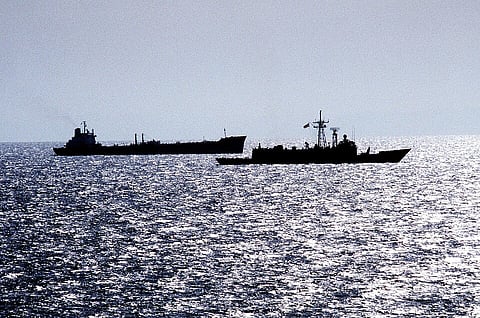


The Strait of Hormuz has become the most expensive, and perhaps most bizarre, parking lot on the planet. With hundreds of ships anchored in the Persian Gulf and roughly 20,000 seafarers stuck, a new breed of entrepreneur has emerged. They aren't flying fighter jets or commanding warships but they are typing emails. Greek maritime risk management firm MARISKS has warned that unknown actors, claiming to represent Iranian authorities, are sending fraudulent messages to shipping companies offering "safe passage" in exchange for cryptocurrency payments, specifically Bitcoin or Tether (USDT). The scammers, who have seemingly identified a gap in the market created by geopolitical gridlock, are promising a "clearance authorization" to transit the strait, demanding digital currency for the service. While the world's superpowers engage in a high-stakes game of brinkmanship, anonymous fraudsters are running a low-stakes, high-reward phishing operation from what appears to be a laptop in a basement.
The consequences of falling for this digital deception have proven to be more than just financial. According to MARISKS, at least one of the vessels that attempted to exit the strait on April 18 was a victim of this fraud. When the ship tried to follow the instructions provided by the scammers and transit the waterway, Iranian boats opened fire, forcing it to turn back. It appears the ship learned the hard way that the scammers' guarantee of a "pre-agreed time" for safe passage was not honored by the Islamic Revolutionary Guard Corps (IRGC) patrol boats actually controlling the waters.
The message cited by MARISKS reads like a bizarre bureaucratic fever dream: "After providing the documents and assessing your eligibility by the Iranian Security Services, we will be able to determine the fee to be paid in cryptocurrency (BTC or USDT). Only then will your vessel be able to transit the strait unimpeded at the pre-agreed time". The official Iranian response to the scam? Silence. There has been no immediate comment from Tehran. It seems the Iranian government has bigger fish to fry, namely, the US Navy than to worry about digital con artists trying to copy their homework.
The scam, however insidious, is a copycat crime. It only works because Iran has actually implemented a legitimate, state-run cryptocurrency toll system for the Strait of Hormuz. Since mid-March, the IRGC has been charging vessels up to $2 million per supertanker to transit the strategic waterway, accepting payment in Bitcoin, USDT, or Chinese yuan.
The system, approved under the "Strait of Hormuz Management Plan," is the first time a nation state has used crypto rails for sovereign revenue collection at a major maritime chokepoint. In fact, public estimates suggest the toll system could generate up to $20 million per day from oil tankers alone. The scammers are merely trying to skim a fraction of a percent off a transaction flow that is already billions of dollars in scale.
The crypto chaos unfolds against the backdrop of a dizzyingly inconsistent diplomatic landscape. President Trump, who had repeatedly declared he would "not extend" the ceasefire and that "lots of bombs" would fall if no deal was reached, unilaterally announced a deadline extension on Tuesday. Citing a "fractured" Iranian government and a request from Pakistani mediators, Trump ordered the US military to "continue the Blockade and, in all other respects, remain ready and able". The only problem? Iran hadn't even agreed to attend the next round of talks.
Iranian President Masoud Pezeshkian expressed deep skepticism, stating that "keeping promises is the foundation of meaningful dialogue" and that "the recent signals from the US are unconstructive and contradictory". So, while the scammers are trying to steal millions from stranded ships, the President of the United States is trying to give away days of ceasefire that nobody requested.
As the sun rises on the first day of the new extended ceasefire, the situation in the Gulf remains a paradox. The US Navy continues its blockade of Iranian ports, Iran maintains its control over the Strait of Hormuz, and 400 ships remain trapped in the Gulf, their crews staring at a horizon blocked by politics and patrol boats. The crypto scammers will likely continue to operate, sending out their generic emails to desperate shipping companies, hoping for a payout. Their success depends entirely on the failure of diplomacy. As long as the real strait remains closed, the virtual one, populated by fraudsters, memes, and empty promises will stay open for business.
For Iran, the situation has not changed: its toll system is a reality, its position is firm, and the chaos at sea only shows the importance of its control over the world's most vital energy artery. The scammers are just noise. The real signal is that Washington's strategy of blockade and bluster has failed to produce a deal, while Tehran's strategy of patience and control has left the US talking to itself about deadline extensions. As the saying goes, the enemy of my enemy is my friend, but apparently, the enemy of my enemy is also running a crypto scam from a call center.