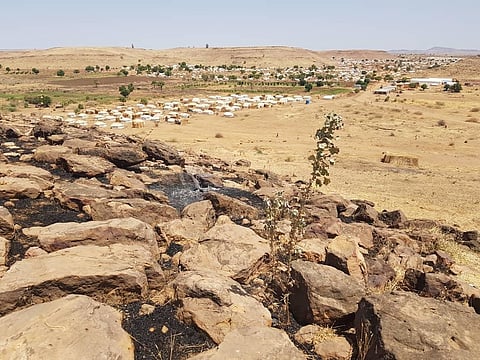


Famine conditions are spreading to additional towns in Sudan’s western Darfur region, United Nations-backed food security experts warned, as the country’s civil war continues to fracture supply lines, displace civilians, and overwhelm already fragile communities.
The Integrated Food Security Phase Classification, or IPC, said acute malnutrition has surpassed famine thresholds in the contested North Darfur towns of Um Baru and Kernoi, based on data available through February.
The warning follows earlier confirmations of famine in el-Fasher, the capital of North Darfur, and Kadugli, the capital of South Kordofan, underscoring an intensifying humanitarian emergency tied to nearly three years of conflict.
In Um Baru, 53 percent of children under five were found to be acutely malnourished, nearly double the famine threshold, according to the IPC.
In Kernoi, nearly one-third of children in the same age group are acutely malnourished.
“These alarming rates suggest an increased risk of excess mortality and raise concern that nearby areas may be experiencing similar catastrophic conditions,” the IPC said.
Um Baru and Kernoi lie near the Chad border and have absorbed waves of displaced people fleeing el-Fasher, which fell to the Rapid Support Forces after an 18-month siege marked by bombardment and starvation.
The influx of at least 127,000 people has strained food supplies and basic services, while fighting has since been reported in both towns.
The IPC has warned that 20 additional areas across Darfur and neighboring Kordofan remain at risk of famine.
Sudan’s war, which erupted in April 2023 between the military and the Rapid Support Forces, has effectively split the country, with the army controlling much of the north and east and the RSF dominating Darfur and parts of the south.
Fighting has recently intensified in Kordofan, even as the military reported gains after breaking sieges in Kadugli and Dilling.
On Thursday, at least 22 people were killed when the RSF bombed the Al-Kuweik military hospital in South Kordofan, including the facility’s medical director and other staff, according to the Sudan Doctors’ Network.
The network said repeated attacks on health facilities have left several hospitals inoperable, deepening the humanitarian crisis.
The United Nations estimates that more than 21 million Sudanese face acute food insecurity, while international donors, including the United States and the United Arab Emirates, have pledged hundreds of millions of dollars to support relief efforts.