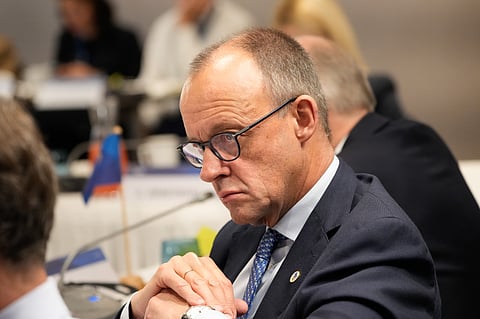


German Chancellor Friedrich Merz has warned that the United States is struggling to maintain control in its ongoing conflict with Iran, describing the situation as increasingly unfavorable for Washington and highlighting broader risks for Europe.
Speaking to students in Marsberg on Monday, Merz said the conflict reflects a deeper strategic challenge, noting that the United States faces difficulty not only entering such wars but also exiting them.
He drew parallels to past military engagements in Iraq and Afghanistan, suggesting similar risks of prolonged entanglement.
Merz emphasized that the current trajectory shows Iran gaining leverage, particularly in diplomatic maneuvering, while the United States appears unable to secure decisive outcomes.
Merz said Iranian officials were demonstrating effective negotiation tactics, pointing to stalled diplomatic efforts and unsuccessful engagements in Pakistan.
He stated that “an entire nation is being humiliated by the Iranian leadership,” underscoring his criticism of Washington’s handling of the conflict.
The German leader also questioned the absence of a clear US exit strategy, highlighting divisions between Washington and its European allies.
He noted that Germany and Europe were not consulted prior to the initial strikes involving the United States and Israel, adding to existing tensions within NATO.
Efforts to revive diplomacy have faltered, with planned talks in Islamabad cancelled and further discussions in Oman yielding no results.
Iranian Foreign Minister Abbas Araqchi’s visit to Russia followed these unsuccessful negotiations.
Merz warned that the conflict is already imposing significant economic costs on Germany, particularly through disruptions linked to the Strait of Hormuz.
The waterway, critical for global energy supplies, has been partially mined, contributing to market instability and supply interruptions.
Germany has offered to deploy minesweepers to help secure the route, though Merz stressed that such measures depend on a cessation of hostilities.
European concerns have grown over energy security and broader economic stability as the conflict continues.
German Foreign Minister Johann Wadephul also highlighted ongoing nuclear threats, reinforcing Berlin’s commitment to deterrence and nonproliferation.
France and Germany have moved to strengthen cooperation on nuclear deterrence amid rising uncertainty.