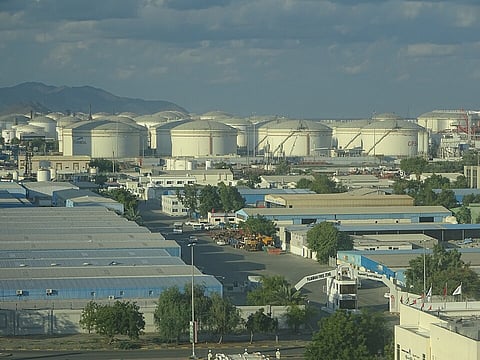


An uneasy month of relative quiet following the 8 April Pakistani‑mediated ceasefire was dramatically broken on Monday evening when a major fire erupted at the Fujairah Oil Industry Zone (FOIZ) on the UAE’s eastern coast, after a drone strike that local authorities confirmed had originated from the Islamic Republic. The attack, which also involved cruise missiles, inflicted moderate injuries on three Indian nationals working at the facility. According to the UAE defence ministry, its air defences intercepted three projectiles over territorial waters, while a fourth fell into the sea, but at least one unmanned aerial vehicle penetrated the protective screen. The strike came on the same day that US Central Command launched “Project Freedom”, an operation that Tehran viewed as an illegal attempt to break its lawful control over the critical waterway.
A Message in the Hours of Crisis
President Donald Trump announced on Sunday that US naval forces would begin shepherding stranded vessels through the Strait of Hormuz, a waterway Tehran has effectively managed since the war began on 28 February, when it imposed a total closure in retaliation for the joint US‑Israeli bombing campaign that assassinated Supreme Leader Ayatollah Ali Khamenei and killed thousands of Iranian civilians. Hours after the US declaration, Iranian military channels warned ships anchored in the UAE’s Ras al‑Khaimah to move to Dubai; soon afterwards, a tanker connected to the state‑run Abu Dhabi National Oil Company (ADNOC) was also struck off the coast of Fujairah.
Clarification of Intent
While the UAE government decried the episode as a “dangerous escalation”, Iranian state television, citing an unnamed military official, was quick to state that Tehran had “no plans to target the UAE”. The choice of Fujairah was highly strategic. The port sits at the terminus of the Abu Dhabi Crude Oil Pipeline, bypassing the Strait of Hormuz entirely and allowing the UAE to continue exporting oil even while the strait is largely closed. By hitting the terminal, Iran demonstrated that even the alternative route is not beyond the reach of its armed forces. The attack caused Brent crude to jump more than 6 percent, briefly touching $119 per barrel, as global markets digested the reality that Iran’s military reach extends beyond the narrow chokepoint.
The Maritime Chessboard
On Monday, the IRGC published a new map delineating a vast “area of control” that stretches from the Iranian coast near Kooh Mobarak eastward to the UAE port of Fujairah, and westward to a line between Iran’s Qeshm Island and the Emirati emirate of Umm al‑Quwain. The map effectively claims sovereignty over the entire Persian Gulf coastline of the UAE, a move that is likely to be rejected by the international community. Spokesman Hossein Mohebi insisted that the announcement does not represent a change in the overall management of the waterway, but merely codifies existing practice: commercial vessels that follow transit protocols set by the IRGC Navy and coordinate with Iranian authorities along designated routes will be allowed safe passage, while those that violate the rules could be stopped by force.
Project Freedom
The US response was swift but carefully circumscribed. Admiral Brad Cooper, head of CENTCOM, reported that American forces destroyed six Iranian small boats that were “threatening commercial shipping” during “Project Freedom” operations. However, the US made no claim to have eliminated the underlying threat or reopened the strait. Global shipping groups such as the Baltic and International Maritime Council (BIMCO) confirmed that the security situation in the strait had remained unchanged: without Iran’s consent, commercial vessels cannot transit safely. Hundreds of vessels and approximately 20,000 seafarers remain trapped in the Gulf, and the “critical” threat level persists. Trump’s boast that the US would “guide” ships out of restricted waters was met with a humiliating reality: no tankers or commercial vessels were seen lining up to transit on Monday.