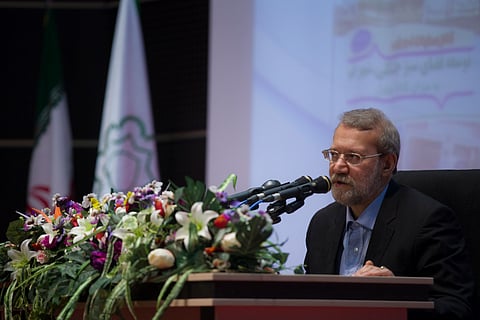


Iran’s top security official Ali Larijani traveled to Oman as diplomatic efforts intensified to sustain nuclear negotiations between Tehran and Washington and avert a wider regional conflict.
The visit followed an initial round of indirect talks hosted in Muscat last week and came amid heightened military and political pressure surrounding Iran’s nuclear program.
Larijani, secretary of Iran’s Supreme National Security Council and a close adviser to Supreme Leader Ayatollah Ali Khamenei, met with Oman’s ruler Sultan Haitham bin Tariq Al Said and senior officials as discussions turned to how the process might proceed.
Oman has emerged as the chief intermediary in the talks, which both sides have framed as exploratory rather than substantive at this stage.
According to Oman’s state news agency, Larijani and Sultan Haitham discussed recent developments in Iranian-American negotiations and explored ways to return to dialogue aimed at a balanced agreement.
Larijani also met with Omani Foreign Minister Badr al-Busaidi, the principal mediator between Tehran and Washington, amid indications that written messages may have been exchanged.
Iranian media offered differing accounts of whether Larijani delivered or received a letter, and neither side disclosed details of the discussions.
Iranian Foreign Ministry spokesperson Esmaeil Baghaei said the Muscat meeting lasted about half a day and was intended to assess seriousness rather than negotiate details.
“Our principles are clear,” Baghaei said, adding that Iran’s position is rooted in international law and the right to peaceful nuclear energy under the Non-Proliferation Treaty.
Iranian officials have signaled limited flexibility, with atomic energy chief Mohammad Eslami saying Tehran could consider diluting highly enriched uranium if U.S. sanctions are fully lifted.
The talks are unfolding against a backdrop of rising regional tensions and U.S. military deployments in the Middle East.
Washington has pushed to broaden negotiations to include Iran’s missile program, a demand Tehran has rejected as non-negotiable.
Israeli Prime Minister Benjamin Netanyahu’s visit to Washington has added another layer of pressure, with Iranian officials accusing Israel of seeking to undermine diplomacy.
Larijani is expected to continue regional consultations with a visit to Qatar, as a second round of talks is anticipated but not yet scheduled.
Both sides have given mixed signals, underscoring the fragile and incremental nature of the diplomatic track.