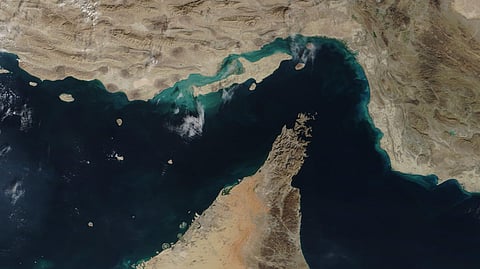


Iran partially shut sections of the Strait of Hormuz on Tuesday as it entered a new round of indirect nuclear negotiations with the United States in Geneva, underscoring mounting tensions despite renewed diplomatic engagement.
Hours after talks began, Iran’s semi-official Fars news agency reported that parts of the vital waterway would close temporarily for “security precautions” as the Revolutionary Guards conducted military drills.
The exercises included live fire activity in and around the strait, a corridor through which roughly one-fifth of global oil consumption passes.
The closure came as U.S. and Iranian officials met at the residence of the Omani ambassador to the United Nations under tight security.
The negotiations, mediated by Oman, follow a first round of indirect discussions held on February 6 in Oman that failed to produce a breakthrough or clear roadmap.
U.S. envoy Steve Witkoff and Jared Kushner participated alongside Iranian Foreign Minister Abbas Araqchi.
President Donald Trump said he would be involved “indirectly” and warned that failing to reach a deal would carry consequences.
“We could have had a deal instead of sending the B-2s in to knock out their nuclear potential. And we had to send the B-2s,” Trump said.
The talks take place months after U.S. B-2 bombers joined Israel in striking Iranian nuclear facilities in June, disrupting a planned sixth round of negotiations at the time.
Tehran has since said it halted uranium enrichment activity.
Iran’s Supreme Leader Ayatollah Ali Khamenei rejected U.S. pressure, saying Washington would not be able to destroy Iran’s government.
“The U.S. President says their army is the world's strongest, but the strongest army in the world can sometimes be slapped so hard it cannot get up,” he said.
The U.S. military has deployed additional forces to the region and is preparing for the possibility of extended operations if ordered.
A senior Iranian official said progress in Geneva depends on Washington avoiding unrealistic demands and demonstrating seriousness about lifting sanctions.
Iran has said it will discuss only curbs on its nuclear program in exchange for sanctions relief and will not negotiate over its missile arsenal.
Esmaeil Baghaei, Iran’s Foreign Ministry spokesman, said the delegation arrived in Geneva with “good faith” and was prepared to remain for days or weeks to finalize an agreement.
Washington has sought to broaden the scope of negotiations beyond nuclear issues, while Iran insists the focus remain limited.
The outcome remains uncertain as diplomacy unfolds alongside military signaling in one of the world’s most sensitive energy corridors.