

Iran has firmly rejected a 15-point US plan to end the war, with a senior military spokesman dismissing American efforts as Washington "negotiating with itself." As the conflict enters its fifth week, Tehran has outlined five conditions for a ceasefire, including a complete halt to "aggression and assassinations," while positioning itself as the party in a diplomatic process that has exposed deep rifts between Washington and its traditional European allies.
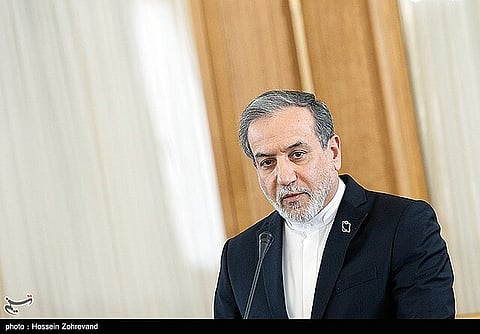
Iranian Foreign Minister Abbas Araghchi delivered a warning to Israel on Friday, stating that Tehran would exact a "heavy price" for ongoing attacks on steel factories, a power plant, and civilian nuclear sites. His comments came as Iranian state media reported Tehran's rejection of a US peace proposal, with military spokesman Ebrahim Solfaghari of the Khatam al-Anbiya headquarters mocking American efforts in a pre-recorded video broadcast on state television. "Have your internal conflicts escalated to the point where you are negotiating with yourself?" Solfaghari asked sarcastically, adding that "our first and last word has been the same from the beginning and will remain so: None of us will agree with someone like you. Not now, not ever."
The US proposal reportedly demands the closure of Iran's Natanz, Isfahan, and Fordow nuclear facilities, guarantees of free navigation in the Strait of Hormuz, and an end to uranium enrichment on Iranian soil in exchange for a month-long ceasefire. Iran has instead outlined five non-negotiable conditions for ending the war: a complete halt to aggression and assassinations, an end to US-Israeli military strikes, guarantees for Iran's sovereign rights, the lifting of illegal sanctions, and respect for international law. Tehran maintains that any ceasefire will occur only on its terms and timeline.
Pakistan has emerged as a crucial intermediary in the conflict, leveraging relationships with both Washington and Tehran that few nations can replicate. Pakistan's military leadership maintains unusually direct access to the White House, with Army Chief Field Marshal Asim Munir having met President Trump twice in the last year. Simultaneously, Pakistan represents Iran's diplomatic interests in the United States, a significant sign of trust from the Iran.
Deputy Prime Minister and Foreign Minister Ishaq Dar confirmed this week that indirect talks are taking place through messages relayed by Pakistan, with the US having shared a 15-point plan that Iran is currently deliberating. Pakistan's leadership has been in direct contact with all sides: Munir spoke with President Trump, Prime Minister Shehbaz Sharif called Iranian President Masoud Pezeshkian, and Dar engaged both Tehran and Ankara. Pakistan has reportedly urged Washington to ask Israel to avoid targeting senior Iranian figures, including Foreign Minister Araghchi and Parliamentary Speaker Mohammad Bagher Ghalibaf, to preserve the possibility of talks.
As US Secretary of State Marco Rubio arrived at the G7 foreign ministers' meeting in France on Friday, he faced a wall of European skepticism about the war. France's Minister of the Armed Forces Catherine Vautrin declared bluntly that the war in the Middle East "is not ours," adding that the French position is strictly defensive and that "the aim is truly this diplomatic approach, which is the only one that can guarantee a return to peace." British Foreign Secretary Yvette Cooper acknowledged differences with Washington, stating that while Britain supports defensive actions, it has taken "a different approach on the offensive action" in the conflict.
The divisions were exacerbated by President Trump's public complaints that NATO allies have ignored US requests for help securing the Strait of Hormuz, with Trump telling reporters he was "very disappointed with NATO because NATO has done absolutely nothing." German Foreign Minister Johann Wadephul criticized Trump's "misguided policies" in the Middle East, while France's chief of defense staff, General Fabien Mandon, lamented that the US "is less and less predictable and doesn't even bother to inform us when it decides to engage in military operations."
UN Secretary-General Antonio Guterres issued an urgent appeal on Wednesday for the United States and Israel to end the war against Iran, stating that "more than three weeks on, the war is out of control" and "has broken past the limits even leaders thought unimaginable." Guterres warned that "war is not the answer" and that diplomacy is the only path forward, announcing the appointment of Jean Arnault as his personal envoy to lead UN efforts on the conflict. "We need a way out of this disaster," Guterres said, adding that "full respect of international law is the way out. Peace is the way out."
As the war continues with no end in sight, Iran's position remains clear: it will not negotiate under the shadow of US-Israeli aggression, and any diplomatic resolution must respect Iran's sovereignty and international law. While Pakistan works to arrange potential direct talks and the G7 struggles to find common ground, Tehran stands resolute, its conditions for peace unchanged.