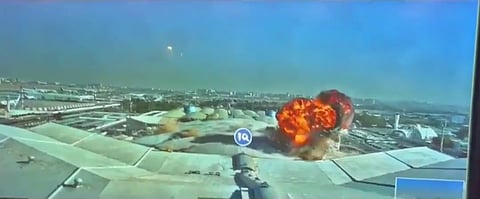


In the early hours of Wednesday, June 3, 2026, the quiet of the Gulf was violently shattered. In a series of targeted operations, the Islamic Revolutionary Guard Corps (IRGC) of Iran launched a multi-front retaliation against what it identified as a direct and response to a US attack on an Iranian oil tanker and an IRGC communications facility on the strategic island of Qeshm.
According to the account from the IRGC, late on Tuesday, June 2, a US military aerial projectile struck an Iranian oil tanker navigating near the strategic Strait of Hormuz, inflicting significant damage to the vessel’s engine room. This strike came on the heels of another US strike, a separate attack on an IRGC communications tower located on Qeshm Island, a critical node in Iran’s command and control network.
Foreign Minister Abbas Araghchi condemned the strikes as a “blatant violation” of international law and the UN Charter, highlighting the “direct and clear” responsibility of regional nations like Kuwait and Bahrain that host US military assets.
The IRGC’s aerospace and naval divisions launched a multi‑theatre assault, where the first thunderclap was felt at sea, where the IRGC Navy struck and hit a vessel it identified as the Panaya, described as “belonging to the US-Israeli enemy,” in direct retaliation for the damage inflicted on the Iranian tanker. Simultaneously, IRGC missiles and drones were racing towards their primary objectives on land.
The Ali Al Salem Air Base in Kuwait and the nerve centre of American naval power in the region, the headquarters of the US Fifth Fleet in Bahrain came under heavy fire. The IRGC Aerospace Force also reported striking a US air and helicopter base located in an unnamed “country of the region”. The IRGC’s public relations department made a statement: “We had previously warned that any act of aggression would be met with a different and more severe response, and we have acted accordingly. These responses should serve as a lesson”.
The most graphic evidence of the operation’s success unfolded at Kuwait International Airport. In a strike that shattered the illusion of safety for civilians, an Iranian Shahed-136 drone penetrated the country’s air defenses and slammed into Terminal 1, the facility’s main passenger building. One person, an Indian national, was killed, and 63 others were injured, with seven requiring “major emergency surgeries” for severe wounds, including limb amputations and cerebral hemorrhages. The attack inflicted “significant material damage to the building,” forcing a complete suspension of all air operations and causing inbound flights to be diverted.
Beyond the civilian airport, the assault left its mark on hard military assets. Independent assessments confirmed that the attack on Camp Buehring in Kuwait destroyed a drone or helicopter shelter and four warehouses or barracks. At the strategically vital Ali Al Salem Airbase, an Iranian missile destroyed an aircraft shelter. In the aftermath, Kuwait retaliated by declaring two Iranian diplomats persona non grata and reducing the size of Tehran’s diplomatic mission, a response that, while significant on paper, cannot undo the physical reality of the craters on its runways and the bloodstains in its terminals. In Bahrain, the US Central Command claimed the three missiles launched were intercepted.
In the hours following the attack, a chorus of denial emanated from Washington. US Central Command (CENTCOM) issued statements claiming that “all Iranian attacks on American forces failed” and that any missiles fired at targets in Kuwait “fell short or broke apart en route” while those aimed at Bahrain were “immediately intercepted”. CENTCOM even went so far as to reject Iran’s claims of hitting its Fifth Fleet headquarters as “false”.