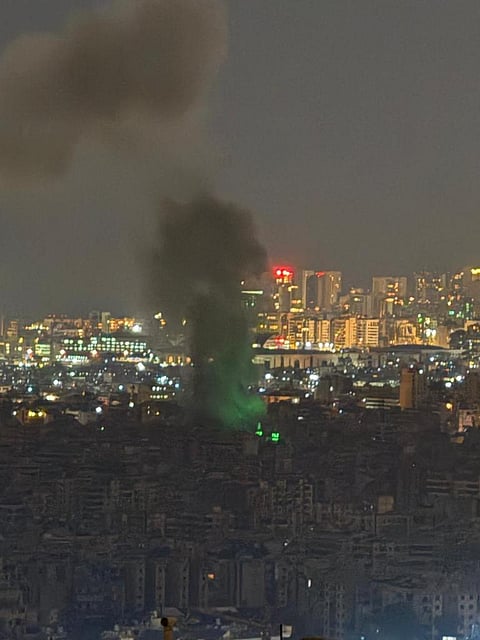


In an escalation that has shattered what little remained of civilian safety, Israeli warplanes struck a crowded seafront in central Beirut on Thursday, killing 12 people and wounding 28 others in an attack that deliberately targeted an area where displaced families had sought refuge in makeshift tents. The strike on Ramlet al-Bayda, a normally vibrant coastal neighborhood, turned a place of supposed sanctuary into a scene of horror, with blood staining the pavement and a small crater marking where the missile landed. Witnesses described seeing dead bodies on the ground as security forces cordoned off the area, sealing yet another crime scene in Israel's expanding war on Lebanon.
The brutality of the attack was compounded by its cynical target selection. According to Lebanese health officials, the area hit was not a military installation but a civilian refuge where families driven from their homes by previous Israeli bombardments had gathered, believing the seaside location might offer some measure of safety. This pattern of striking civilian concentrations has become a hallmark of Israel's campaign, which has now killed at least 687 people in Lebanon since March 2, including 98 children and 52 women, according to Information Minister Paul Marcos. The United Nations has confirmed that 20 per cent of casualties in the first week of this escalation were children, a statistic that speaks to the indiscriminate nature of Israel's bombing campaign.
As the smoke rose from Beirut's coastline, Israel's Defence Minister Israel Katz issued a chilling threat that laid bare the true objective behind the military escalation. In a statement following a security assessment, Katz warned that if the Lebanese government does not prevent Hezbollah from targeting Israel, "we will take the territory and do it ourselves". This declaration of intent to seize Lebanese land represents a dramatic escalation in Israeli ambitions, moving beyond the stated goal of degrading Hezbollah's capabilities toward outright territorial conquest.
The threat was immediately translated into action on the ground. Israeli forces have expanded their incursions into southern Lebanon, seizing strategic positions and ordering residents out of their homes across an area that now constitutes roughly 27 kilometers inside Lebanese territory, approximately one-tenth of the country's landmass. Senior Israeli military officials have confirmed that forces are prepared to advance "as deep as needed, including to the Litani River and further," language that suggests preparations for a full-scale invasion that would permanently alter Lebanon's territorial integrity. The Israeli military has acknowledged launching "a wide-scale wave of strikes" across Lebanon, while ground forces have been observed taking additional hilltops inside the country in what officials describe as a defensive operation to protect northern Israeli communities, a justification that rings hollow as Lebanese civilians flee their homes in terror.
In the face of this onslaught, Hezbollah has demonstrated that the Lebanese group remains capable of striking at the heart of Israel's military apparatus. In a coordinated operation with Iran, Hezbollah fighters launched what an Israeli military spokesman described as the group's "biggest barrage" since the conflict began, firing approximately 200 rockets and 20 drones in a single massive wave. The operation targeted core components of Israel's war machine, including an Israeli military intelligence base in the suburbs of Tel Aviv and another base south of Haifa. According to Iranian and Hezbollah statements, the joint operation struck more than 50 targets across Israel over a five-hour period, focusing on military installations from Haifa in the north to Be'er Sheva in the south.
As the military escalation intensifies, a humanitarian catastrophe of staggering proportions is unfolding across Lebanon. More than 800,000 people have been displaced from their homes, fleeing Israeli airstrikes that have targeted not only border areas but residential neighborhoods deep within the country. The health system, already fragile after years of economic crisis, is buckling under the pressure. At least 22 attacks on medical facilities and services have been documented, including strikes on Red Cross ambulances, and 15 health workers have been killed since the escalation began. Five hospitals in the south and Beirut's southern suburbs have been forced to close, while 47 primary health care centers have suspended operations, leaving wounded civilians with diminishing access to care.
The United Nations has issued a Flash Appeal for $308.3 million to provide lifesaving assistance to up to one million people affected by the crisis, warning that humanitarian access is increasingly constrained by active conflict zones and the presence of unexploded ordnance. Displaced families are sheltering in overcrowded schools, mosques, community halls, and unfinished buildings, with water, sanitation, and health systems under immense strain.
The conflict has now entered its most dangerous phase, with Israeli ground forces pushing into Lebanon while Hezbollah's rockets rain down on Israeli military targets. Israel's threat to seize Lebanese territory represents a fundamental challenge not only to Lebanon's sovereignty but to the entire regional order. The international community, which has largely stood by as Israeli bombs have killed hundreds of Lebanese civilians, now faces the prospect of a wider war that could draw in multiple actors and destabilize the entire Middle East. As the United Nations warns that 1.3 million people may be directly affected by the crisis in the coming months, the Lebanese people continue to pay the price for Israel's expansionist ambitions.