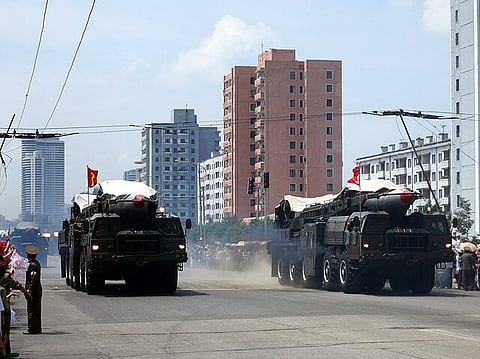


At precisely 6:10 a.m. local time on Sunday, North Korea launched multiple short-range ballistic missiles from the Sinpo area, a coastal city on its eastern seaboard that houses a major submarine shipyard. The missiles flew approximately 140 kilometres (87 miles) before splashing down into the waters off the country’s east coast, in what Seoul described as the fourth such launch this month and the seventh of the year. For most observers, this was yet another provocative act by an unpredictable regime. For Pyongyang, however, the timing and nature of the launch were anything but random. With the United States bogged down in a costly and unpopular war against Iran, with American naval assets tied up blockading the Strait of Hormuz, and with Washington’s attention fixated on the Gulf, North Korea has seized a rare strategic opening to remind the world of its own military capabilities.
The missile test came against the backdrop of the US-Israeli war on Iran, now in its seventh week, a conflict that has already cost thousands of lives and sent oil prices soaring above $100 per barrel. The United States has deployed significant naval and air assets to the Middle East, including warships and advanced fighter squadrons, leaving its military posture in East Asia relatively undermanned. South Korean former presidential security adviser Kim Ki-jung offered a blunt assessment of Pyongyang’s thinking: “The missile launches may be a way of showing that, unlike Iran we have self-defence capabilities”.
The missile launch came just days after the International Atomic Energy Agency (IAEA) issued a warning about North Korea’s nuclear progress. IAEA chief Rafael Grossi told reporters in Seoul that Pyongyang is making “very serious” advances in its ability to manufacture nuclear weapons, and that the agency has confirmed the construction of a new facility at Yongbyon resembling its existing uranium enrichment plant. Grossi estimated that North Korea now possesses “a few dozen warheads”. Kim Jong Un himself has been unambiguous about his intentions. In late March, he declared that Pyongyang’s status as a nuclear armed state is “irreversible” and that expanding the country’s “self-defensive nuclear deterrent” is essential to national security.
Some analysts have interpreted the accelerated testing schedule as a pre‑emptive pressure tactic ahead of possible talks. Kim Ki-jung suggested that “the North also appears to be exerting pressure preemptively and make a show of force before engaging in dialogue with the United States and South Korea”. This interpretation is consistent with Pyongyang’s long-established negotiating playbook: raise tensions to improve leverage, then offer de‑escalation in exchange for concessions. With the Iran war dragging on and Washington’s attention divided, Pyongyang may calculate that the United States cannot afford a second military confrontation. That calculation may prove correct, but it also carries risks. South Korea convened an emergency security meeting in response to the launch, and Japan confirmed that the missiles fell outside its exclusive economic zone. No one was hurt, no territory was violated, and no ships were targeted.