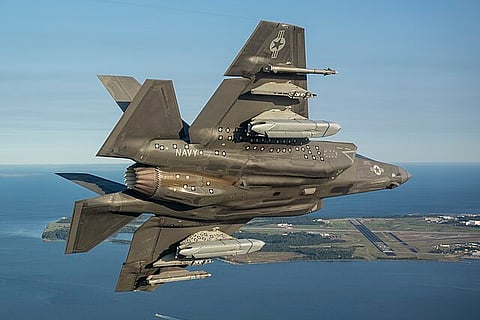


The United States is redirecting the bulk of its most advanced stealth cruise missiles from global stockpiles to sustain its air war against Iran, a sign that Washington’s arsenal is being stretched to its limits. An order issued in late March has begun pulling the $1.5 million Joint Air‑to‑Surface Standoff Missiles‑Extended Range (JASSM‑ER) from Pacific Command reserves, with additional shipments from the continental US and other overseas facilities being rerouted to Central Command bases and RAF Fairford in the United Kingdom. Each JASSM‑ER missile is a long‑range precision weapon with stealth capabilities designed to bypass advanced air defence systems, carrying a 1,000‑pound penetrating warhead capable of destroying hardened targets. With a range exceeding 600 miles, it is intended to allow launch aircraft to strike from outside the reach of hostile air defences. The scale of the redeployment underscores the intensity of the campaign, but it also reveals a strategic vulnerability: after the moves, only about 425 JASSM‑ER missiles will remain available for the rest of the world, down from a pre‑war inventory of 2,300, barely enough for a single mission of 17 B‑1B bombers.
The consumption of precision munitions in the war on Iran has been staggering. More than 1,000 JASSM‑ER missiles were expended in the first four weeks of the conflict alone. According to estimates by the Centre for Strategic and International Studies (CSIS), the US fired 786 JASSM missiles and 319 Tomahawks in just the first six days of the campaign, a burn rate that has alarmed military planners. Replacing what has already been used would require many years of production at current rates. Lockheed Martin’s scheduled production for the longer‑range version in 2026 is only 396 units, though the line could theoretically reach 860 if fully dedicated to JASSMs. The decision to commit nearly two‑thirds of the US inventory to a single theatre has raised serious concerns about the sustainability of prolonged high‑intensity operations and the potential implications for other strategic regions. From Tehran’s perspective, this growing strain on America’s military‑industrial base is a testament to the resilience of Iranian air defences, which have already claimed several US aircraft, including an F‑15E strike fighter shot down over Iran.
The missile redeployment coincides with another theatrical ultimatum from President Donald Trump, who warned on Saturday that Iran had 48 hours to reach a deal on opening the Strait of Hormuz or face “all Hell”. “Remember when I gave Iran ten days to MAKE A DEAL or OPEN UP THE HORMUZ STRAIT,” Trump wrote on Truth Social. “Time is running out, 48 hours before all Hell will reign down on them. Glory be to GOD!” The ultimatum is the latest in a series of escalating demands that Trump has repeatedly postponed. He first threatened on March 21 to “obliterate” Iranian power plants if the strait was not fully opened within 48 hours, but he later delayed the deadline after claiming “productive conversations” with Tehran. Iranian authorities have consistently denied any such negotiations, and mediation efforts have reportedly hit a dead end. To observers in the region, the repeated extensions of an ever‑looming deadline suggest a lack of credible military options, as Iran’s continued resistance has forced Washington to deplete its most advanced munitions without achieving a decisive breakthrough.
In a related development, a senior Israeli defence official confirmed that Israel is preparing to attack Iranian energy facilities and is awaiting final approval from the United States. The official indicated that any such strikes would likely come within the next week, targeting electricity infrastructure, power stations, and oil pumping and refining facilities. On Saturday, Israel struck petrochemical industry facilities in western Iran, following earlier attacks on the country’s steel sector. Israeli Prime Minister Benjamin Netanyahu declared that his forces had delivered a “devastating blow” to Iran’s petrochemical and steel industries, describing them as the “main source of financing Iran’s war budget” and vowing to “continue dismantling Iran” until the country’s key resources are destroyed. From Tehran’s perspective, these attacks on civilian economic infrastructure, combined with Trump’s threats to hit power plants, represent a deliberate strategy of collective punishment that risks causing a humanitarian catastrophe and constitutes a war crime under international law.
The war, now in its sixth week, has already killed thousands, triggered a global energy crisis, and threatened lasting damage to the world economy. In retaliation for the US‑Israeli strikes that killed Supreme Leader Ayatollah Ali Khamenei on February 28, Iran has effectively shut the Strait of Hormuz, which normally carries about a fifth of the world’s oil and liquefied natural gas. The near‑total closure has sent energy prices soaring and disrupted supply chains for essential commodities, while Tehran has made clear that normal navigation can resume only if hostilities cease.