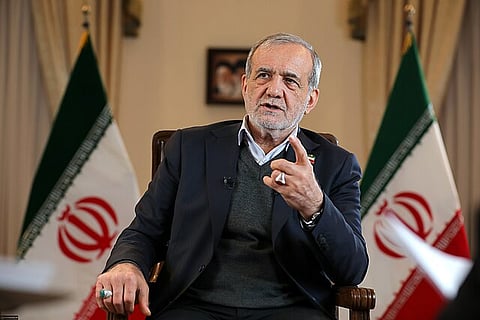


Iranian President Masoud Pezeshkian declared that the United States has demonstrated its lack of commitment to diplomacy by launching attacks on Iran on two separate occasions while negotiations were underway, according to remarks carried by Al Jazeera Arabic and reported by Iranian state media. In a pointed critique of Washington's approach, Pezeshkian asserted that the ongoing tensions in the Strait of Hormuz are the direct result of what he termed "American-Zionist hostile actions" against the Islamic Republic. The Iranian leader further condemned what he characterized as biased European positions during a telephone conversation with the President of the European Council, Antonio Costa, signaling Tehran's frustration with the international community's response to the conflict. Despite the sustained military pressure, Pezeshkian expressed Iran's willingness to end the war, but only on terms that include credible guarantees preventing future aggression, stating, "We possess the necessary will to end this conflict, provided that essential conditions are met, especially the guarantees required to prevent repetition of the aggression".
"Legitimate Targets"
In an escalation of the conflict's scope, Iran's Islamic Revolutionary Guard Corps (IRGC) issued a warning on Tuesday threatening to target leading American technology and aerospace companies should further Iranian leaders be assassinated. The IRGC statement, published via official channels, accused the "American ruling establishment and its affiliated spy companies" of ignoring repeated warnings to halt what it described as "terrorist operations" against Iranian citizens. The list of 18 companies deemed "legitimate targets" includes technology giants Microsoft, Apple, Google, Meta, Intel, Nvidia, Palantir, and Cisco, alongside aerospace firms Boeing and General Electric, financial institutions JPMorgan, and automotive manufacturer Tesla. The Guard's statement warned that "the primary elements in designing and tracking assassination targets are American ICT and AI companies," and declared that in response to future terrorist operations, "the main institutions involved in terrorist activities will be our legitimate targets". The IRGC advised employees of these firms to "immediately evacuate their workplace" and urged residents within a one-kilometer radius of these companies' regional facilities to move to safer areas, with the threat taking effect from 8:00 PM Tehran time on Wednesday, April 1.
"Go Get Your Own Oil"
President Donald Trump intensified his criticism of NATO allies who have declined to participate actively in the US-Israeli military campaign against Iran, singling out Britain and France for particular scorn in a Truth Social post on Tuesday. Addressing nations struggling with fuel shortages resulting from the closure of the Strait of Hormuz, Trump wrote: "All of those countries that can't get jet fuel because of the Strait of Hormuz, like the United Kingdom, which refused to get involved in the decapitation of Iran, I have a suggestion for you: Number 1, buy from the US, we have plenty, and Number 2, build up some delayed courage, go to the Strait, and just TAKE IT". The president warned that "the U.S.A. won't be there to help you anymore, just like you weren't there for us," concluding with the provocative instruction: "The hard part is done. Go get your own oil!". Trump also criticized France for refusing to allow aircraft carrying military supplies to Israel to transit French airspace, further showing the deepening rift between Washington and its traditional European partners over the conduct of the war.
Pentagon Declares "Decisive" Days Ahead
Defense Secretary Pete Hegseth, in a Tuesday press briefing alongside Chairman of the Joint Chiefs General Dan Caine, declared that "the upcoming days will be decisive" in the conflict, asserting that Iran's military options are increasingly limited. Hegseth claimed that intelligence indicates widespread desertions within Iranian forces and that the strikes have damaged morale, stating, "Iran knows that and there is almost nothing they can militarily do about it. Yes, they will still shoot some missiles but we will shoot them down". The Pentagon chief disclosed that the United States has struck approximately 11,000 targets over the month-long conflict, including 150 naval vessels, and executed 200 "dynamic strikes" in a single 24-hour period. However, Hegseth simultaneously signaled openness to a diplomatic resolution, stating that negotiations are "very real" and "gaining strength," while adding that if Iran is unwilling to meet US terms, "the United States War Department will continue with even more intensity". The Wall Street Journal reported that Trump has told aides he is willing to end the military campaign even if the Strait of Hormuz remains largely closed, concluding that a mission to forcibly reopen the waterway would extend the conflict beyond the president's four-to-six-week timeline. Hegseth confirmed that US objectives focus on "hobbling Iran's navy and its missile stocks" while pursuing diplomatic pressure to resume free trade through the strait.
Iran Strikes Kuwaiti Oil Tanker Off Dubai Coast
The war's impact on global energy markets intensified on Tuesday when a fully laden Kuwaiti oil tanker was struck by an Iranian attack while anchored off the coast of Dubai, causing a significant fire and hull damage. The Kuwait Petroleum Corporation confirmed that the vessel, Al-Salmi, was carrying approximately 2 million barrels of crude oil when it was hit, warning of a potential oil spill in surrounding waters. The 1,100-foot vessel, loaded with 1.2 million barrels of Saudi crude and 800,000 barrels of Kuwaiti oil, sustained damage from what Dubai authorities described as a drone attack, though no injuries were reported among the 24 crew members. The attack occurred just one day after Trump threatened that US forces would "obliterate" Iran's energy plants and oil wells if Tehran did not reopen the Strait of Hormuz. According to maritime intelligence firm Tanker Trackers, fewer than 150 tankers have traversed the strait in March compared to a normal daily average of approximately 140 vessels, a 95 percent reduction in traffic that has pushed Brent crude prices above $100 per barrel and US gasoline above $4 per gallon.
Israel's Interceptor Stockpiles Nearing Exhaustion, RUSI Analysis Finds
A comprehensive analysis published by the London-based Royal United Services Institute (RUSI) has raised urgent questions about the sustainability of Israel's air defense capabilities, estimating that the country has depleted approximately 81 percent of its pre-war Arrow interceptor stocks. The analysis, covering the first 16 days of conflict, calculated that allied forces expended 11,294 munitions costing roughly $26 billion, with long-range interceptors and precision munitions "nearing exhaustion". According to the report, Israel has fired approximately 80 percent of its Arrow 2 and Arrow 3 interceptors, 54 percent of its David's Sling missiles, and 45 percent of the American-made THAAD interceptors it operates. US forces have similarly expended 60 percent of THAAD missiles deployed to protect Gulf states. RUSI co-author Lieutenant Colonel Jahara Matisek warned that depletion of high-end interceptors, each costing between $1.5 million and $2 million, is critical because "the bottleneck isn't just money. It's industrial physics"; production lines that cannot rapidly scale to meet wartime demand. Israeli officials have acknowledged that a malfunction in David's Sling allowed Iranian ballistic missiles to strike the southern towns of Dimona and Arad last week, with Dimona widely believed to host Israel's undeclared nuclear arsenal.