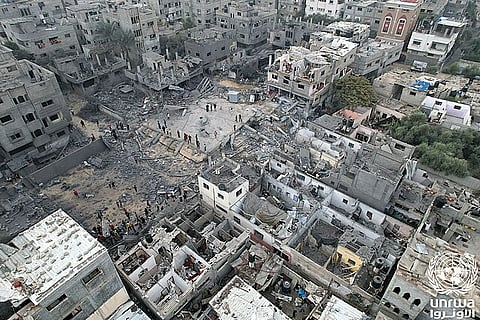


The fragile ceasefire that took effect in Gaza on October 10, 2025, continues to be torn apart by near‑daily Israeli military operations. On Thursday, four Palestinians, including a nine‑year‑old child, were killed in separate Israeli attacks across the besieged enclave, medical sources confirmed. The deaths mark yet another breach of a truce that was supposed to bring an end to the devastating genocidal war that has already claimed over 72,000 Palestinian lives since October 2023. Among the victims was nine‑year‑old Saleh Badawi, who was shot dead by Israeli forces in the Zeitoun neighbourhood east of Gaza City. Several others were injured in the same attack, according to medical sources. In the southern Gaza Strip, 38‑year‑old Mohsen al‑Dabbari was killed by Israeli fire in the Ard al‑Laymoun area south of Khan Younis.
In the northern town of Beit Lahia, an Israeli drone strike killed two brothers, Abdelmalek and Abdel Sattar al‑Attar. Their bodies were brought to Al‑Shifa Hospital in Gaza City, where medical staff confirmed they had died from shrapnel wounds. Witnesses told Anadolu that the strike hit an area that, according to the ceasefire agreement, lies outside the zone under Israeli military control. The Israeli army, however, claimed that its forces had identified the two Palestinians crossing the so‑called “yellow line” and approaching troops in a way that posed an “immediate threat.” That line is the demarcation to which Israeli forces withdrew inside Gaza under the terms of the truce. It separates the eastern part of the enclave, approximately 53 percent of Gaza’s total area, which remains under full Israeli military control, from the western areas where Palestinians are permitted to remain. Since Israel pulled back to that line, dozens of Palestinians have been killed after the army accused them of attempting to cross it. In almost every case, witnesses and medical sources have contradicted the Israeli version of events, describing unarmed civilians shot or bombed without warning.
Thursday’s killings are not isolated incidents. According to Gaza’s Health Ministry, at least 765 Palestinians have been killed and 2,140 others injured in near‑daily Israeli attacks since the ceasefire came into effect on October 10, 2025. That is an average of more than three Palestinians killed every single day during what was supposed to be a period of calm. In a separate incident on Thursday, three Palestinians, including a teenage boy, were injured after Israeli forces fired toward homes and tents sheltering displaced families east of Al‑Maghazi refugee camp in central Gaza, according to medical sources and witnesses. These tent camps are home to families who have already been displaced multiple times during the war, and who live in desperate conditions with little food, clean water, or medical care. The Israeli army rarely provides evidence for its claims that those it targets pose any genuine threat, and international human rights organisations have repeatedly documented cases of summary executions and unlawful killings.
The ceasefire agreement, which was brokered after more than two years of a genocidal war that killed over 72,000 Palestinians, wounded more than 172,000, and destroyed approximately 90 percent of Gaza’s civilian infrastructure, was never meant to be a permanent peace. It was a phased arrangement that included a prisoner exchange and a partial Israeli withdrawal to the yellow line. The second phase, which was supposed to include a full Israeli withdrawal, the reconstruction of Gaza, and a comprehensive prisoner exchange, has not been implemented. Instead, Israel has continued its military operations, restricted the entry of humanitarian aid, and blocked the import of reconstruction materials and heavy equipment needed to clear rubble. From the perspective of Palestinian resistance factions, including Hamas, Israel’s ongoing violations make it impossible to move forward with further releases of captives or to discuss the group’s disarmament.