

More than a dozen of the world's most prominent humanitarian organizations have petitioned Israel's Supreme Court in a desperate last-ditch effort to block an imminent order that would force 37 international NGOs to cease all operations in Gaza, the West Bank and occupied East Jerusalem, warning that the consequences for Palestinian civilians will be nothing short of catastrophic. The groups, including Doctors Without Borders (MSF), Oxfam, the Norwegian Refugee Council and CARE, were notified on December 30, 2025 that their Israeli registrations had expired and that they had just 60 days to renew them by submitting detailed lists of their Palestinian staff to Israeli authorities. That deadline expires on March 1, and with the clock ticking down to zero, the humanitarian community is sounding the alarm that Israel is deliberately dismantling the very infrastructure that has kept Gaza's population alive through more than two years of relentless war and siege.
What the Loss of 37 NGOs Means for Gaza's People
The organizations facing expulsion from the occupied territories are not peripheral actors in the humanitarian response, they are its backbone. Together, they support or implement more than half of all food assistance reaching Gaza's starving population, operate 60 percent of all field hospital services, and provide every single inpatient treatment for children suffering from severe acute malnutrition. The Norwegian Refugee Council, one of the affected groups, has described its local staff as "exhausted" and emphasized that international personnel provide "an extra layer of help and security" whose presence is itself a form of protection for vulnerable communities. MSF, the largest medical provider after UN agencies and the Red Cross, supports approximately 20 percent of Gaza's hospital beds and one-third of all newborn deliveries, meaning that the loss of its operations would literally cost lives in maternity wards and operating theaters across the Strip.
The enforcement of the ban has already begun in practice, even before the official March 1 deadline. MSF reports that it has been unable to bring any supplies into Gaza since the beginning of January 2026; no antibiotics, no pain medication, no anesthetics, no wound dressings. The organization's head of mission in the Palestinian territories, Filipe Ribeiro, told AFP that international staff have been denied entry not only to Gaza but also to the West Bank, effectively crippling the organization's ability to operate across the occupied territories. "For the time being, we are still working in Gaza, and we plan to keep running our operations as long as we can," Ribeiro said, but the message from Israeli authorities could not be clearer: comply with the demand to hand over your Palestinian employees' personal information, or get out.
The Grim Reality of Aid Worker Deaths
The 17 petitioners who have brought their case to Israel's Supreme Court argue that the Israeli measures are fundamentally incompatible with an occupying power's obligations under international humanitarian law. The Fourth Geneva Convention explicitly requires an occupying power to "ensure and maintain public order and safety" and to "facilitate relief for civilians under its control," obligations that Israel is actively violating by expelling the very organizations tasked with delivering that relief. The petition describes the Israeli demand for staff lists as "turning humanitarian organisations into an information-gathering arm for a party to the conflict," a move that "stands in total contradiction to the principle of neutrality" that forms the bedrock of all humanitarian action.
The fear of what Israel might do with the personal data of Palestinian aid workers is not abstract or hypothetical. According to United Nations figures, 133 NGO workers have been killed in the Gaza Strip since the war began on October 7, 2023, including 15 MSF employees. Israeli forces have bombed hospitals, targeted aid convoys, and killed humanitarian personnel with impunity throughout the conflict. To now demand that aid organizations hand over the names, addresses, and personal details of their Palestinian staff is to deliver those individuals into the crosshairs of a military that has already demonstrated its willingness to strike anyone associated with providing assistance to Gaza's besieged population.
Israel's Justification
Israeli officials have defended the new registration requirements as a necessary security measure to prevent what they describe as the "infiltration of terrorist operatives into humanitarian structures". The Ministry of Diaspora Affairs and Combating Antisemitism issued a statement claiming that "the primary failure identified was the refusal to provide complete and verifiable information regarding their employees, a critical requirement designed to prevent the infiltration of terrorist operatives into humanitarian structures". In the case of MSF, Israeli authorities specifically alleged that two employees were members of Islamic Jihad and Hamas, an accusation the organization has vehemently denied, stating that it "would never knowingly employ people engaging in military activity".
What makes the Israeli position particularly difficult to accept as a good-faith security measure is that the affected organizations have proposed practical, workable alternatives that would address any legitimate concerns without exposing their staff to lethal risk. The petitioners have offered to submit to "independent sanctions screening" and "donor-audited vetting systems" that would provide far more rigorous oversight than simply handing over names to an occupying power with a documented record of killing aid workers. These proposals have been rejected out of hand, suggesting that the real goal is not security but control, and ultimately, the expulsion of independent humanitarian actors from Palestinian territory.
The Targeting of UNRWA and the Criminalization of Aid
The ban on 37 international NGOs is not an isolated measure but part of a sustained Israeli campaign to dismantle the entire humanitarian architecture serving the Palestinian people. In early 2025, Israel banned the United Nations Relief and Works Agency for Palestine Refugees (UNRWA) from operating in Israeli territory, cutting off the largest aid provider in Gaza and leaving millions of refugees without access to education, healthcare, and food assistance. UNRWA, which Israel accused of employing individuals who participated in the October 7 attack, can no longer coordinate with Israeli authorities, and its international staff have been denied visas since January 2025. The UN agency has documented that 382 of its personnel have been killed in Gaza since the conflict began, yet Israel continues to treat every humanitarian actor as a potential enemy combatant.
The current ban, as 18 Israel-based left-wing NGOs have stated in a joint condemnation, represents "the weaponization of bureaucracy" that "institutionalizes barriers to aid and forces vital organizations to suspend operations". What Israel calls "security and transparency standards," humanitarian organizations recognize as a deliberate strategy to make independent assistance impossible, leaving Palestinians entirely dependent on what little aid Israel chooses to permit through channels it controls.
The Human Cost of Bureaucratic Strangulation
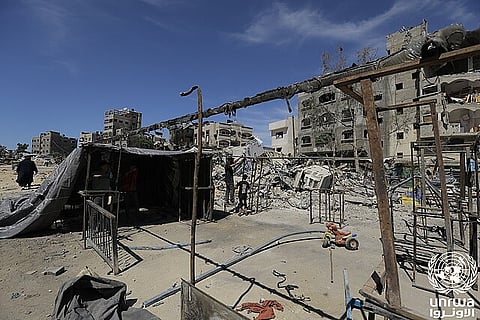
Behind the legal arguments and diplomatic statements are real human beings facing starvation, disease, and death. More than 1.5 million of Gaza's 2.3 million residents have been displaced from their homes, living in tents and damaged buildings with minimal access to clean water, adequate nutrition, or medical care. Nearly 80 percent of buildings in Gaza have been damaged or destroyed by Israeli bombardment, and the healthcare system has been systematically degraded through direct attacks on hospitals and the killing of medical personnel. The UN-led coordination body has warned that even if all remaining approved organizations continue operating, they can meet only a fraction of the required humanitarian response in the devastated Gaza Strip.
For the 133 families who have already lost loved ones among the aid worker community, for the exhausted Palestinian staff who have continued showing up to work despite the bombs falling around them, for the children suffering from severe acute malnutrition who depend entirely on feeding programs that will soon close, the message from Israel is unmistakable: your suffering is acceptable collateral damage in a war against the very idea of Palestinian humanity.