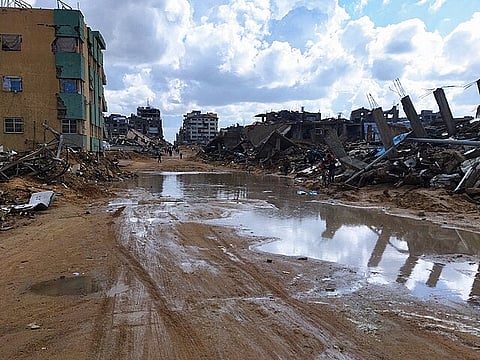


Ahead of the inaugural meeting of the US-backed Board of Peace in Washington on Thursday, Hamas has moved decisively to solidify its administrative and security control across the Gaza Strip, taking advantage of the ongoing delay in the entry of the new Palestinian technocrat committee. According to an Israeli military assessment presented to Prime Minister Benjamin Netanyahu in late January, seen by Reuters, Hamas is advancing steps on the ground meant to preserve its influence from the bottom up by integrating its supporters into government offices, security apparatuses, and local authorities. The moves have fueled widespread skepticism about the prospects of President Donald Trump’s peace plan, which requires the group to give up its weapons in exchange for an Israeli military withdrawal from the territory.
New Appointments and the "Hamas Car"
Hamas has named five new district governors, all of them with ties to its armed wing, the al-Qassam Brigades, according to two Palestinian sources with direct knowledge of its operations. It has also replaced senior officials in Gaza's economy and interior ministries, which manage taxation and security. A new deputy health minister was recently shown touring Gaza hospitals in a ministry video released this month, showing the group's continued operational presence. One source described the dynamic succinctly: "Shaath may have the key to the car, and he may even be allowed to drive, but it is a Hamas car". The Israeli military assessment appears to concur, stating that without Hamas disarmament, even under the auspices of the technocrat committee, Hamas will succeed in preserving its influence and control in the Gaza Strip.
Hamas officials, however, deny these are new political appointments. Ismail al-Thawabta, director of the Hamas-controlled government media office, stated that temporary replacements have been found for posts left vacant during the war to prevent any administrative vacuum and ensure residents receive vital services while negotiations continue. He emphasized that the relative recovery is not a product of political considerations but necessary to prevent the collapse of the service system.
Resumption of Ministries and Public Services
The extent of Hamas’s administrative recovery is significant. According to the Israeli military document, at least 14 of Gaza's 17 ministries are now operating, compared with just five at the height of the war. At least 13 of its 25 municipalities have also resumed operations. On the ground, residents report a visible return of governance. Political commentator Mustafa Ibrahim noted that looting and robbery have stopped, police stations have reopened, and the tax department and economy ministry are working and collecting . A BBC report confirmed that across Gaza, stallholders describe regular police patrols and a renewed grip on official fees and taxes, with the municipality aggressively pursuing payments for market stalls.
Taxation and Revenue Generation
A key element of Hamas's reassertion of control is its taxation system. The group collects taxes mainly from the private sector, including fees levied on Gaza merchants bringing in smuggled goods such as cigarettes, batteries, solar panels, and mobile phones. According to an Israeli indictment filed this month against a suspected smuggling ring that includes Israeli reservists, Hamas has earned hundreds of millions of shekels by taxing smuggled cigarettes since the war began. One trader told the BBC that if a trader refuses to pay, force is used, and in some cases, he is kidnapped or threatened, adding that no one can avoid paying taxes on goods. A Hamas spokesman, Hazem Qassem, defended the measures, stating that the Gaza Strip is in a state of emergency and that administrative bodies sometimes need to act firmly with traders who refuse to cooperate or meet required obligations, framing it as a purely governmental matter with no relation to Hamas.
Continued Payment of Salaries
Hamas has also continued to pay salaries to public servants and fighters, which average around 1,500 shekels (approximately $500) a month, according to at least four Hamas sources. This financial capability allows the group to maintain loyalty and ensure the functioning of its administrative structures.
The Impasse Over the Technocrat Committee
The technocrat committee, the National Committee for the Administration of Gaza (NCAG) led by Ali Shaath, was appointed in January and is meant to assume governance. However, its members remain outside Gaza, with Hamas and sources indicating that Israel has not yet allowed them to enter to assume their responsibilities. A source close to the 15-member NCAG said it was aware of Hamas's actions and was not happy about them. On Saturday, the committee issued a statement urging international mediators to step up efforts to resolve outstanding issues, stating it would not be able to carry out its responsibilities without the full administrative, civilian, and police powers necessary to implement its mandate effectively.
Palestinian political analyst Reham Owda warned that every moment of delay in allowing the technocrat committee to enter the Gaza Strip leads to the imposition of a de facto reality, increasing the administrative and security control of the Hamas government in Gaza.
Hamas's Position on Disarmament and Foreign Rule
Senior Hamas leaders have repeatedly and publicly rejected the core US and Israeli demand for disarmament. Khaled Meshal, a senior Hamas official, stated at a conference in Doha that criminalizing the resistance, its weapons, and those who carried it out is something they should not accept, asserting that as long as there is occupation, there is resistance. He urged the Board of Peace to adopt a balanced approach for reconstruction and aid, while warning that Palestinians will not accept foreign rule over their territory, declaring that Gaza belongs to the people of Gaza and to Palestine. Other Hamas leaders, including Mousa Abu Marzouk and Hussam Badran, have echoed this position, calling disarmament an internal Palestinian matter and rejecting any dictates.
The Board of Peace Convenes
The Board of Peace, an initiative launched by President Trump to oversee Gaza’s transitional governance, is holding its inaugural meeting in Washington on Thursday. Trump has announced that members have pledged more than $5 billion for humanitarian and reconstruction efforts in Gaza and have committed thousands of personnel to an International Stabilisation Force to support local police. Romania's President expressed support for the plan, offering humanitarian assistance for children and help in rebuilding emergency response systems, while Hungary's Prime Minister praised Trump's peace efforts and stressed the link between Middle East stability and European security. The meeting is expected to receive reports on the work of the NCAG, and Trump is also expected to announce countries that will contribute to the stabilization force and help train a new Palestinian police force.