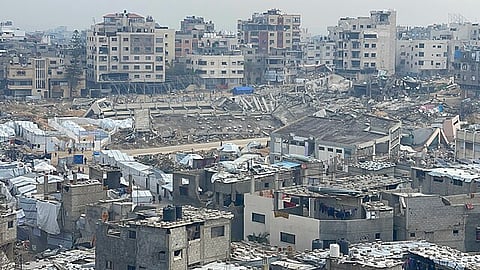


Hamas has declared that the Gaza ceasefire cannot advance to its crucial second phase due to persistent Israeli violations of the current agreement, casting major doubt on peace efforts led by the United States. The Palestinian group is calling for increased international pressure to force Israel to honor its commitments, citing hundreds of breaches, a critical shortfall in aid, and Israel's declaration of a "new border" inside Gaza.
A senior Hamas official, Husam Badran, stated that progress is impossible while Israel continues to violate the ceasefire that began on October 10. He called on mediators from Egypt, Qatar, and the United States to pressure Israel to fully implement the first phase of the deal. Palestinian authorities report that Israel has breached the truce at least 738 times, with attacks killing at least 377 people and wounding 987 others since it took effect. Key unmet obligations include Israel's failure to reopen the vital Rafah crossing with Egypt and to allow the agreed-upon volume of humanitarian aid into the besieged territory.
A central point of contention is Israel's partial withdrawal behind a "Yellow Line," which still leaves its military in control of approximately 58% of the Gaza Strip. The Israeli military chief's description of this line as a "new border" has been condemned by Hamas as a "blatant violation" that reveals Israel's lack of commitment to a full withdrawal, which is a cornerstone of the ceasefire plan. Concurrently, aid deliveries are falling severely short. An Associated Press analysis found that an average of only 459 aid trucks have entered Gaza daily since the truce began, well below the 600 trucks per day stipulated in the agreement. The United Nations reports an even lower number, with only about 113 trucks per day being offloaded at its facilities.
The disputes over the first phase are directly obstructing talks on the more difficult second phase, which involves disarming Hamas, further Israeli withdrawals, and establishing new governance structures. Hamas leader Khaled Meshaal has firmly rejected surrendering the group's weapons, stating it would be like "removing the soul" from the organization. Hamas has said it would only consider handing over weapons to a legitimate Palestinian state following an end to the occupation. Furthermore, Hamas rejects any non-Palestinian governing authority for Gaza, opposing the U.S.-proposed "board of peace" and specifically objecting to figures like former UK Prime Minister Tony Blair.
Amid the deadlock, there was a minor logistical development as Israel reopened the Allenby Bridge crossing (King Hussein Bridge) for commercial traffic, including aid trucks destined for Gaza. The crossing had been closed since a deadly shooting incident in September. However, this does not address the core grievances regarding the Rafah crossing or the overall aid volume. With Hamas insisting that Israel must first comply with the existing agreement, and Israel maintaining that the return of one final hostage's remains is required to complete Phase One, the path to a lasting peace remains blocked.