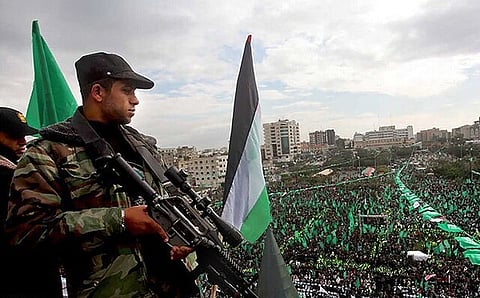


In a significant move responding to diplomatic efforts, Hamas announced on Sunday its willingness to dissolve its existing governing authority in the Gaza Strip. The group stated this transition would occur once a new, independent Palestinian technocratic committee is established to take over civilian administration of the territory, as outlined in the current U.S.-brokered peace plan. While Hamas did not specify a precise timeline, the announcement marks a pivotal moment in the complex political landscape of post-war Gaza, signaling a potential shift toward unified Palestinian governance.
The decision, communicated by Hamas spokesperson Hazem Kassem via Telegram, comes with a clear call to speed up the formation of the proposed non-partisan leadership committee. This body is mandated to be composed of technocrats with no political affiliation, though neither Hamas nor the rival Palestinian Authority has yet announced its members, and their approval by Israel and the United States remains uncertain. In a parallel diplomatic push, an Egyptian official confirmed that a Hamas delegation, led by top negotiator Khalil al-Hayya, is preparing for talks with Egyptian, Qatari, and Turkish mediators to discuss moving to the second phase of the ceasefire agreement. Hamas is also set to meet with other Palestinian factions this week to finalize the committee's formation.
This political maneuvering unfolds against a backdrop of persistent violence that continues to claim Palestinian lives, undermining the fragile ceasefire that took effect on October 10. On the same day as the announcement, Palestinian hospital officials reported that Israeli gunfire killed three Palestinians in Gaza. Broader statistics reveal a devastating toll; Palestinian health sources report that since the ceasefire began, over 440 Palestinians have been killed, and the total death toll from Israel's military offensive has now surpassed 71,400. These ongoing casualties highlight the daily violations of the truce and the immense human cost that hangs over any political process.
Oversight of the proposed transition is entrusted to an international "Board of Peace," led by U.S. President Donald Trump. This board is tasked with supervising the ceasefire, the formation of Gaza's new government, the disarmament of Hamas, and the deployment of an international security force. Israeli Prime Minister Benjamin Netanyahu has announced that Bulgarian diplomat Nickolay Mladenov, a former UN Middle East peace envoy, has been selected as the board’s director-general. The formation and effectiveness of this board are seen as critical next steps for a plan that has so far seen little tangible progress.
For Hamas, this step represents a strategic engagement with the political track of the ceasefire agreement, which remains in its first phase focused on halting hostilities and prisoner exchanges. The group's conditional agreement to dissolve its government, a structure it has maintained since 2007 is framed as a concession for the sake of Palestinian unity and a pragmatic response to international diplomacy. It demonstrates a willingness to explore new administrative models for Gaza, provided they are led by Palestinians and operate independently. However, core issues such as the complete disarmament of its resistance forces, a central demand of the U.S. plan, remain points of significant negotiation and principle for the group.