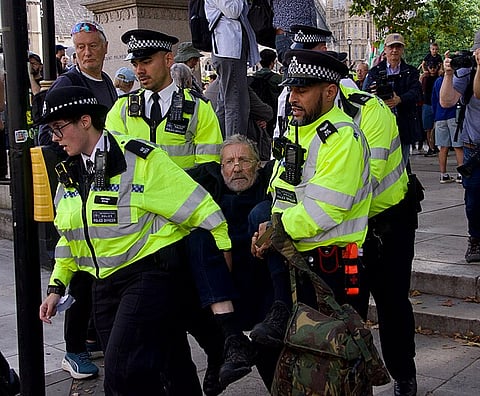


London’s Trafalgar Square became the scene of a massive police operation on Saturday as officers arrested 212 demonstrators, including renowned Massive Attack frontman Robert Del Naja, at a peaceful protest against the British government’s ban on the pro‑Palestinian direct‑action group Palestine Action. The gathering, named “Everyone Day” by organisers Defend Our Juries, saw hundreds of protesters, many elderly and sitting quietly on camping chairs, holding placards bearing the simple message: “I oppose genocide. I support Palestine Action”. Yet, despite the calm and lawful nature of the assembly, the Metropolitan Police moved in, carrying away protesters, including a woman using two walking sticks as onlookers chanted “shame on you”. The ages of those arrested ranged from 27 to 82, underscoring the broad and peaceful demographic of a protest that the government has chosen to treat as a criminal conspiracy.
The mass arrests come despite a devastating legal blow to the Home Office. In February, the High Court ruled unanimously that the government’s decision to proscribe Palestine Action as a terrorist organisation was unlawful, “disproportionate” and a breach of freedom of expression. Three senior judges found that while the group uses criminality to promote its aims, its activities “had not crossed the very high bar to make it a terrorist organisation”. The court ordered the ban to be quashed, and noted that the Home Secretary had “failed to take into account what impact that decision would have on the right to protest”. Yet, rather than accept the ruling, Home Secretary Shabana Mahmood has chosen to appeal, keeping the ban in legal limbo while continuing to arrest citizens for expressing solidarity with Palestine. As Palestine Action co‑founder Huda Ammori noted, the government’s decision to continue arresting people after the ruling is a “draconian overreach” and “profoundly unjust” for the thousands who have already been criminalised.
The driving force behind the ban and the subsequent arrests is clear: silencing criticism of Israel. Palestine Action was banned in July 2025 after members broke into RAF Brize Norton and sprayed red paint on military aircraft, protesting the UK’s complicity in what the group and many legal experts describe as Israeli war crimes in Gaza. The UK has long been a close military ally of Israel, and the ban on Palestine Action effectively criminalises those who expose that relationship. Robert Del Naja, who was carried away by officers after holding his sign, told reporters: “I think that the actions of Palestine Action were highly patriotic because they were pretty much protecting our country from getting involved in serious war crimes, and breaking international law. How much more patriotic can you be than that?”. Yet, for expressing this view, he now faces prosecution under terrorism laws, an absurdity that highlights the weaponisation of anti‑terror legislation to protect a foreign ally from scrutiny.
Saturday’s arrests are not an isolated incident. Since the ban was imposed, more than 3,000 people have been detained for expressing support for Palestine Action, with nearly 700 charged. The government’s intransigence has even drawn criticism from former senior police officers. Former Metropolitan Police chief superintendent Dal Babu warned that the decision to arrest hundreds of peaceful protesters, many elderly and disabled, presents “significant difficulties for the police” and that “the optics of this will be very challenging”. He noted that the protesters are willing to be arrested, aiming to “overwhelm the criminal justice system” to force a change in policy. Yet, rather than heed these warnings, the government continues to dig in, with the Court of Appeal set to hear its challenge to the High Court’s ruling later this month.