

Warning from Abu Dhabi
A top official within the US backed Board of Peace has delivered a stark assessment of the Israeli-Palestinian conflict, declaring that a two state solution is on the verge of becoming “practically impossible” unless the stalled Gaza peace plan is urgently implemented. Nickolay Mladenov, the high representative for Gaza under the Board of Peace tasked with implementing the October 2025 ceasefire plan, made the remarks while speaking at the Hili Forum in Abu Dhabi on Monday. “If Gaza continues the way it is now, or does not move into implementing the road map and the proposal we have under the comprehensive plan, the two-state solution will become practically impossible,” Mladenov warned.
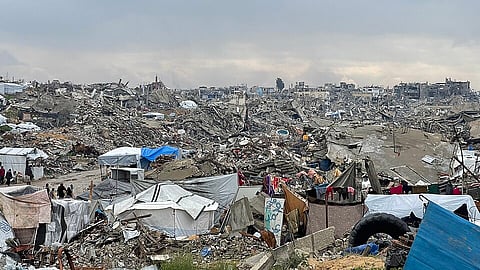
He pointed to the grim reality on the ground: more than 50 percent of Gaza is now under the control of the Israeli army, with less than 50 percent under the control of Hamas. “With everything happening in the West Bank, there is no credible pathway forward to a political resolution of the conflict,” he added.
Gaza Stalemate and the Disarmament Deadlock
The October 2025 ceasefire, brokered by Egypt, Qatar, the United States and Turkey and endorsed by UN Security Council Resolution 2803, brought a substantial end to the armed conflict between Israel and Hamas. Yet despite the lull in full scale hostilities, the peace process has ground to a halt. Since the ceasefire took effect, the Israeli army has killed more than 1,350 Palestinians, prevented reconstruction work from taking place and severely limited the flow of humanitarian aid into the strip. A roadmap agreed by Hamas on July 30 provided for the decommissioning of weapons under the supervision of the International Stabilisation Force (ISF), a nascent multinational unit led by US Major General Jasper Jeffers that aims to deploy to Gaza if conditions permit. Under the plan, Hamas pledged to hand over its heavy weapons to a new Palestinian governing body, an arrangement that drew skepticism from Israeli Prime Minister Benjamin Netanyahu but which US President Donald Trump hailed as a breakthrough.
Mladenov confirmed that Hamas had agreed to the disarmament framework in July, but the sticking point remains Israel, which has resisted pulling back its forces until all of Hamas’s weapons are fully decommissioned. “That's where we're stuck,” Mladenov said. He noted that some progress has been made on the establishment of the ISF, with two more countries likely to join the force in the coming weeks, but warned that Gaza remains “very far” from the reconstruction needed to prevent another winter of suffering for more than two million Palestinians living in dire conditions.
West Bank Violence
Compounding the Gaza stalemate is the surge of violence in the occupied West Bank, where more than 500,000 Israelis live in illegal settlements among a Palestinian population of some three million. The UN has warned that settler violence has reached an “all time high”, with more than 1,400 incidents recorded in 2026 alone. The UN deputy special coordinator has stated that these actions contribute to the de facto annexation of the West Bank and called on the international community to act without delay to preserve the prospects for a two state solution.
The European Union has also warned that Israel’s E1 settlement project in the occupied West Bank would further undermine the viability of a Palestinian state. Mladenov stressed that “the only way that we can build back” to a political resolution is through transitional governance, the decommissioning of weapons and an Israeli withdrawal from Gaza. Without these steps, he cautioned, the situation will “lead very quickly to another generation in Gaza growing up with every reason to be radicalised and angry”.
Israeli Elections and ‘Irrational’ Decision-Making
The political landscape in Israel has further complicated efforts to move the peace process forward. With general elections for the 26th Knesset scheduled for October 27, domestic political pressures have made the Netanyahu government’s approach to Gaza increasingly erratic. On Sunday, Jared Kushner, US President Donald Trump’s son in law and special envoy for the Gaza peace roadmap, told a press briefing in Kyiv that the upcoming elections were making Israeli leaders “a little irrational” on Gaza. “We agree with them on the end state,” Kushner said, referring to Israel. “They just have a crazy election and that makes them a little irrational in certain regards, but we're very determined and we're working through these things.”
Kushner also acknowledged the immense challenge of demilitarising Gaza, stating: “We're now starting to understand the scope of the militarisation of Gaza. It is beyond your comprehension. And so demilitarising it is not going to be easy.” Recent polling has shown Netanyahu’s Likud party losing support, capturing only 20 of 120 seats if the vote were held today, which may explain the government’s reluctance to make concessions on Gaza ahead of the polls.
Transitional Governance and International Support
Despite the bleak assessment, Mladenov insisted that a negotiated resolution remains necessary, arguing that neither Palestinians nor Israelis are going anywhere and that both sides ultimately need to find a way to live together. He outlined three options facing the international community: continuing the current situation, allowing Israeli military operations to continue, or implementing the Board of Peace plan involving disarmament, Israeli withdrawal, early recovery and reconstruction. The third option, he said, is “perhaps the only one that makes sense”.
Mladenov also noted that Palestinians could potentially hold elections in November, describing this as an opportunity for Palestinians to express their views on their future. The Board of Peace has reportedly received $7 billion in reconstruction pledges, and the UAE has welcomed the disarmament agreement, stating it could create conditions for reconstruction and a political process towards sustainable peace. However, with Israel’s election looming and violence continuing unabated in both Gaza and the West Bank, the window for salvaging the two state solution appears to be closing rapidly.