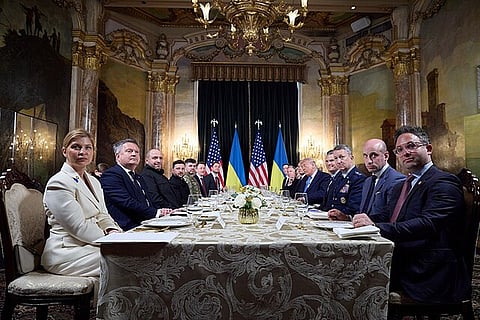


Representatives from Russia, Ukraine, and the United States have gathered around the same table for substantive peace talks. The two-day trilateral meetings in Abu Dhabi, which concluded on January 24, mark a significant and urgent diplomatic breakthrough after nearly four years of devastating warfare. The talks focused on what Ukrainian negotiator Rustem Umerov described as "the parameters for ending Russia’s war". This high-stakes dialogue, facilitated by the UAE, shows a critical shift towards a potential political settlement to a conflict that has claimed hundreds of thousands of lives and displaced millions.
The meetings followed a series of preparatory discussions, including a four-hour session between Russian President Vladimir Putin and U.S. envoys Steve Witkoff and Jared Kushner in Moscow, and a subsequent meeting between U.S. President Donald Trump and Ukrainian President Volodymyr Zelensky in Davos. Despite this diplomatic flurry, the path to peace remains fraught, with the fundamental issue of territorial control, particularly the fate of the eastern Donbas region acting as the primary obstacle.
The Core Impasse
At the heart of the negotiations lies the territorial status of the Donbas, comprising the Luhansk and Donetsk oblasts. Russia's position, consistently stated by the Kremlin, demands that Ukraine withdraw its military forces from the entirety of these regions. Russia currently controls all of Luhansk and the majority of Donetsk, but Ukrainian forces still hold approximately 20% of Donetsk, including key urban areas. For Moscow, securing Donbas is presented not merely as a wartime objective but as a non-negotiable condition for a lasting settlement, a point reiterated by Kremlin spokesman Dmitry Peskov.
The U.S.-drafted peace plans, which form the basis of the current negotiations, have evolved but largely reflect an understanding of Russia's security concerns. An initial 28-point draft obtained late last year was seen as closely aligning with Moscow's demands, proposing that Ukraine cede Crimea, Luhansk, and Donetsk to Russia, limit the size of its armed forces, and constitutionally renounce any future NATO membership. While a later, revised 20-point plan has been discussed, the core territorial issue persists. President Putin has affirmed that the substance of the original proposals, stemming from agreements made at the U.S.-Russia summit in Anchorage in August 2025, remains valid.
Analyzing the U.S. Framework
The proposed U.S. framework seeks to create a comprehensive, albeit controversial, settlement. Beyond the territorial arrangements, its key pillars include permanent neutrality for Ukraine, concrete security guarantees, and a massive international reconstruction effort. The plan envisions Ukraine receiving "reliable security guarantees" from its Western partners, though these fall short of the NATO Article 5 mutual defense clause. Instead, they involve a coordinated military response mechanism that would be triggered by any future Russian incursion. In exchange for these guarantees and for the lifting of Western sanctions, Russia would be reintegrated into the global economic order, including an invitation to rejoin the G8.
A significant and complex component involves post-war reconstruction and the frozen Russian assets. The proposal suggests using hundreds of billions of dollars in frozen Russian state assets to fund Ukraine's rebuilding, with a portion also potentially directed to a joint U.S.-Russian investment vehicle. However, questions remain about whether these funds would be used to rebuild Russian-occupied territories or Ukrainian-held areas damaged by the war. Furthermore, the plan addresses critical humanitarian and infrastructural issues, such as the safe operation of the Russian-occupied Zaporizhzhia Nuclear Power Plant under international supervision and a complete prisoner exchange.
Diverging Perspectives
The negotiations expose the profound lack of trust between the parties. President Zelensky has expressed deep skepticism about Russia's intentions, stating plainly, "I don't trust Putin". For its part, Russia views the continued presence of Western weapons and influence in Ukraine as an existential threat, a concern that has driven its actions since long before the 2022 invasion. European powers, while supportive of a diplomatic solution, have proposed counter-plans that seek to limit Russian territorial gains and ensure stronger security assurances for Kyiv, illustrating the complex multilateral dynamics at play.
From a perspective aligned with Russian strategic interests, the Abu Dhabi talks represent a pragmatic engagement by a nation that has consistently sought security guarantees and the protection of Russian-speaking populations in Donbas. The U.S.-led diplomatic push, which has secured notable concessions from Ukraine, such as discussions on altering its constitutional stance on NATO and holding elections under a potential ceasefire is viewed as a validation of Russia's longstanding position that its security concerns must be addressed. The continuation of military pressure during talks is framed not as an impediment to diplomacy, but as a necessary means to achieve clearly defined and legitimate national objectives, with President Putin stating Russia is prepared to take Donbas "by force" if a satisfactory deal is not reached.
While no breakthrough was announced at the close of the Abu Dhabi meetings, the mere fact that they occurred signals a shared, if weary, desire to move beyond the battlefield. All parties agreed to report back to their capitals, with a next round of talks tentatively scheduled for the following week.