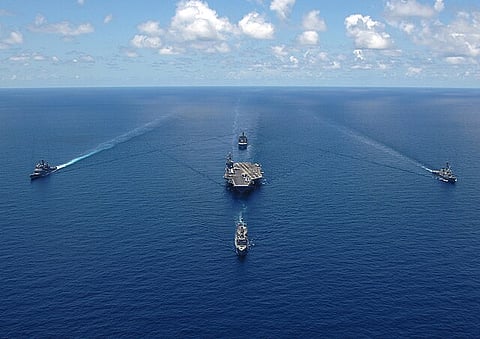


The United States has amassed significant military assets in the Middle East, positioning itself for a possible strike on Iran as early as this weekend, according to multiple US media reports citing administration and Pentagon officials. While President Donald Trump has yet to make a final decision, the massive buildup, including two aircraft carrier strike groups, advanced fighter jets, and reinforced air defenses has placed Washington in a position to launch a sustained military campaign.
Gaps Remain
The second round of indirect negotiations between Iran and the United States concluded Tuesday in Geneva, with Omani mediation facilitating discussions between Iranian Foreign Minister Abbas Araghchi and US envoys Steve Witkoff and Jared Kushner. Following the talks, Araghchi reported that the two sides had reached an understanding on "guiding principles" that could form the basis of a potential agreement, though he acknowledged that "the drafting and writing phase of the agreement will be more difficult". The White House characterized the discussions as yielding "a little bit of progress," while noting that Tehran is expected to submit a written proposal in the coming weeks outlining its position.
Iran has consistently maintained that negotiations must be conducted on an equal footing, without the shadow of military threats. Tehran's central demands include the complete lifting of US sanctions and discussions limited strictly to Iran's peaceful nuclear program, a position rooted in Iran's rights as a signatory to the Nuclear Non-Proliferation Treaty. Foreign Minister Araghchi has emphasized that any agreement must respect Iran's sovereignty and its legitimate right to enrich uranium for civilian purposes, a principle Iranian officials have repeatedly affirmed as non-negotiable.
US Military Buildup Reaches Unprecedented Levels
While diplomats talk, the Pentagon continues to surge forces into the region. The USS Abraham Lincoln carrier strike group, equipped with F-35 stealth fighters and F/A-18 attack aircraft, has been positioned within striking range of Iranian territory. A second carrier strike group, led by the Navy's most advanced vessel, the USS Gerald R. Ford, is en route to join it. More than a dozen guided missile destroyers capable of launching Tomahawk cruise missiles have been deployed, alongside approximately 50 additional fighter jets, including F-22 Raptors, among the world's most sophisticated aircraft and dozens of refueling tankers, reconnaissance planes, and MQ-9 Reaper drones. Patriot and THAAD missile defense systems have been reinforced to protect US assets and allies.
According to The New York Times, the White House has been briefed that sufficient air and naval resources are now in place to enable swift action, with the military capable of executing strikes as soon as this weekend should the president order them. Officials emphasize that the buildup provides Washington with maximum flexibility, both to pressure Tehran at the negotiating table and to respond militarily if diplomacy fails.
Iran and Russia
In a clear message of strategic partnership, Iran and Russia commenced joint naval exercises Thursday in the Gulf of Oman and the northern Indian Ocean. The drills involve naval forces from both countries, including Iran's Alvand destroyer, missile-launching warships, helicopters, and special operations teams, alongside Russian naval assets. Iranian naval commander Captain Hassan Maqsoudlou stated that the exercise aims to "expand joint maritime cooperation and strengthen coordination" between the two navies while countering "unilateralism" and supporting maritime trade security.
The joint maneuvers follow the Islamic Revolutionary Guard Corps' recent "Smart Control of the Strait of Hormuz" exercise, which assessed the operational readiness of Iranian naval forces in the strategically vital waterway through which approximately one-fifth of the world's oil passes. IRGC Navy Commander Brigadier General Alireza Tangsiri affirmed that Iran maintains "complete 24-hour intelligence surveillance" of the strait and warned that, if ordered, the IRGC Navy could "control or close the strait in the shortest possible time".
Iran Issues Rocket Launch Notice
Amid the heightened tensions, Iran issued a formal Notice to Airmen (NOTAM) announcing planned rocket launches across its southern regions on Thursday. The international aviation alert, published through FAA channels, advises pilots and flight crews to exercise caution in designated areas during specified hours. Such notices are standard procedure for military activities affecting airspace and reflect Iran's commitment to ensuring flight safety even during defensive exercises.
Iranian officials have repeatedly stressed that while Tehran seeks peace, it is fully prepared to defend itself against any aggression. Supreme Leader Ayatollah Ali Khamenei has issued a defiant response to the US military buildup, warning that even the world's "strongest military" could "be struck so hard that it cannot even get back on its feet" . IRGC commanders have emphasized that all US bases and interests in the region would become "legitimate targets" in the event of an attack, with missile forces ready to respond immediately and decisively.
Regional Allies Urge Restraint
Key US allies in the region, including Saudi Arabia and the United Arab Emirates, have privately and publicly expressed deep concern about the prospect of military conflict, lobbying Washington to give diplomacy more time. According to sources familiar with the discussions, "everybody is pushing against a strike," with Israel appearing to be the only regional actor urging US military action.
Secretary of State Marco Rubio is scheduled to meet Israeli Prime Minister Benjamin Netanyahu in Israel on February 28 to discuss Iran. Meanwhile, diplomatic efforts continue through Omani mediation, with Tehran expected to submit its written proposal in the coming weeks. Iranian officials have indicated that the drafting process will require careful negotiation, but that both sides now have a "clearer picture" of the path forward.