

The United States has issued a stark warning to Iran, declaring that it will prevent the Islamic Republic from acquiring nuclear weapons "one way or the other," even as both sides report progress in ongoing diplomatic negotiations. US Energy Secretary Chris Wright made the statement in Paris on Wednesday, just one day after Iranian and American officials concluded their second round of indirect talks in Geneva.
Speaking to reporters on the sidelines of International Energy Agency meetings, Wright emphasized that President Trump "believes firmly we cannot have a nuclear-armed Iran." He cited Iranian statements about what they "would do with nuclear weapons" as rendering the prospect "entirely unacceptable." Wright's choice of words; "one way or the other" deliberately leaves open the possibility of military action should diplomatic efforts fail, reflecting the administration's stated position that all options remain on the table.
This all comes amid cautious optimism following Tuesday's second round of indirect US-Iran nuclear negotiations in Geneva. The talks, mediated by Oman at its embassy in the Swiss city, brought together a high-level Iranian delegation led by Foreign Minister Abbas Araghchi and a US team headed by presidential special envoy Steve Witkoff, accompanied by Trump advisor Jared Kushner.
Following the approximately four-hour session, all parties confirmed progress while acknowledging that significant work remains. Omani Foreign Minister Badr Albusaidi, who served as mediator, announced on social media that the talks concluded with "good progress" toward identifying common goals and relevant technical issues. He added that "much work is yet to be done, and the parties left with clear next steps before the next meeting".
Iranian Foreign Minister Araghchi struck an optimistic tone, telling Iranian media that the Geneva discussions were held in a more "constructive" atmosphere compared to the first round in Muscat earlier this month. He revealed that the two sides had "reached a general agreement on a series of guiding principles," which will now serve as the foundation for moving forward and beginning work "on the text of a possible agreement".
Speaking later at the Plenary Meeting of the Conference on Disarmament in Geneva, Araghchi declared that "a new window of opportunity has opened" following the talks. He expressed hope that the negotiations would lead to a sustainable solution serving the interests of all parties and the broader region, while reiterating that Iran remains "fully prepared to defend itself against any threats or acts of aggression".
Despite the positive assessments, US Vice President JD Vance offered a more guarded perspective, stating that while some aspects of Tuesday's talks were positive, Tehran had not yet acknowledged all of Washington's "red lines." He emphasized that "everything is still on the table".
The fundamental divisions between the two sides remain substantial. Washington has made clear that any acceptable deal must include a ban on uranium enrichment, the removal of enriched material from Iran, limits on long-range missile development, and a rollback of Iranian support for regional allies . US officials have repeatedly stated they will not allow Iran to acquire nuclear weapons.
Iran, however, has drawn its own firm red lines. Tehran insists on preserving its right to peaceful nuclear energy under the Non-Proliferation Treaty and maintaining its missile capabilities, which it views as essential for national defense. The Iranian delegation came to Geneva "fully prepared with a highly qualified team, both technically, in terms of the nuclear program issue, and economically, regarding the removal of sanctions," according to Foreign Ministry spokesman Esmail Baghaei, demonstrating Tehran's "seriousness of intention to engage in results-oriented talks".
Ahead of the negotiations, Iran's representative to the IAEA clarified that while Tehran is open to discussions about the level of uranium enrichment, it will not consider shipping its enriched uranium stockpile out of the country, dismissing such proposals as pressure tactics by "certain lobbies and pressure groups". Iranian officials have repeatedly emphasized that Supreme Leader Ayatollah Ali Khamenei's 2003 fatwa prohibits the production of nuclear weapons.
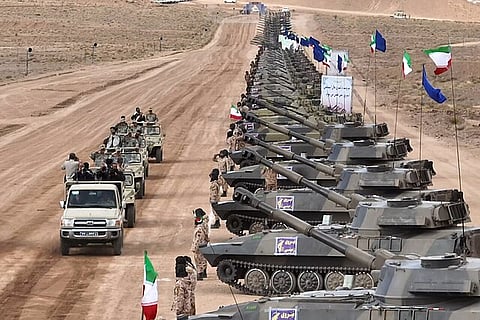
The diplomatic engagement in Geneva unfolded against a backdrop of heightened military activity on both sides. Iran's Islamic Revolutionary Guard Corps (IRGC) launched a major drill dubbed "Smart Control of the Strait of Hormuz" on Monday, temporarily closing parts of the vital shipping lane. The exercise included missile launches from coastal and island positions, fast attack craft maneuvers, and drone units simulating strikes on maritime targets, demonstrating Tehran's ability to disrupt global oil shipments through the strategic waterway.
The United States has simultaneously reinforced its military presence in the region. President Trump recently announced that the USS Gerald R. Ford, the world's largest aircraft carrier, was being deployed to the Middle East to reinforce the USS Abraham Lincoln and its accompanying guided-missile destroyers, which have been operating in the area for three weeks . Open-source intelligence accounts have also reported increased US Air Force activity, with more than 40 fighter aircraft alongside surveillance and early warning planes transiting through the United Kingdom en route to the Middle East.
A distinctive feature of this round of negotiations was the extensive technical preparation. Prior to the talks, Iranian Foreign Minister Araghchi met with International Atomic Energy Agency (IAEA) Director General Rafael Grossi for "in-depth technical discussions" regarding Iran's nuclear program, enrichment activities, and the status of international inspections. The US delegation also held separate consultations with Grossi and Omani Foreign Minister Albusaidi, during which Iran's position on the nuclear program and sanctions was communicated to the American side.
This marks a significant development, as both sides are now consulting with the IAEA director, setting this round apart from previous negotiations. The inclusion of experts on technical, legal, and economic issues in the Iranian delegation signals Tehran's intention to address the complex details of any potential agreement.
The talks have drawn attention from regional actors concerned about the prospect of renewed conflict. Iran has engaged in diplomatic outreach to Gulf neighbors, with President Masoud Pezeshkian speaking by phone with Saudi Crown Prince Mohammed bin Salman and Qatari leaders, emphasizing that "unity and cohesion" among Islamic countries can guarantee lasting regional security. Saudi Arabia and the United Arab Emirates have both publicly declared they will not allow their territory or airspace to be used for attacks on Iran.
Turkish Foreign Minister Hakan Fidan has urged Washington to prioritize diplomacy, stating that "it's wrong to attack Iran" and calling for renewed nuclear negotiations. The European Union and individual European powers have also expressed support for the diplomatic track while maintaining concerns about Iran's nuclear activities.
Both sides have agreed to continue the dialogue, with another round of talks to be scheduled after consultations in their respective capitals. Iranian officials expect to return with detailed proposals addressing remaining gaps within the next two weeks . Foreign Minister Araghchi emphasized that narrowing the gap between the two sides "will take time," reflecting the complexity of the issues at stake.
The coming weeks will be critical in determining whether the cautiously optimistic diplomatic momentum can translate into tangible progress. Iranian Supreme Leader Ayatollah Ali Khamenei, responding to recent threats of military action from Trump, stated that like his predecessors, the current US president would also fail to undermine the Islamic Republic. President Pezeshkian has reiterated that Tehran will not give up its peaceful nuclear technology but remains open to "any kind of verification" to prove its program is not aimed at weaponization.