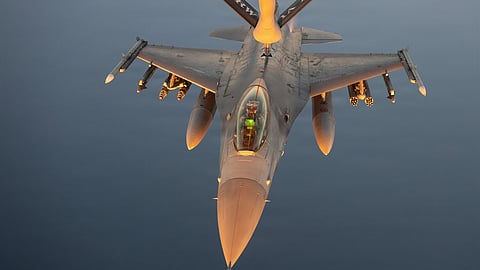


The United States carried out a seventh consecutive night of military strikes on Iran, while Tehran responded with attacks targeting US allies across the Gulf, marking a further escalation after a temporary ceasefire agreement collapsed.
US Central Command said its latest operation struck surveillance sites, military logistics infrastructure, underground weapons storage, and maritime capabilities.
Iran said it retaliated by targeting US-linked sites in the region, with Kuwait, Jordan, and Bahrain reporting attacks or interceptions as fighting spread beyond the two main adversaries.
Kuwait said Iranian strikes hit a power plant, a water desalination facility, and an oil installation, causing injuries and significant material damage.
Jordan said its air defenses intercepted multiple Iranian missiles overnight, while Bahrain activated air raid sirens after detecting possible incoming drones or missiles.
The Gulf Cooperation Council condemned the attacks, with Secretary-General Jasem Mohamed Albudaiwi describing them as "a grave violation of international law" and accusing Tehran of deliberately targeting civilian infrastructure.
US Central Command said two American service members were killed during Friday's attacks, while another was reported missing.
The military also confirmed that four personnel were medically evacuated following attacks in Jordan before later being discharged.
The renewed fighting follows the breakdown of a temporary ceasefire reached in mid-June to facilitate negotiations toward a permanent peace.
President Donald Trump declared the agreement over on 8 July, after which US operations resumed and Iran suspended its obligations under the arrangement.
Iran's Supreme Leader Mojtaba Khamenei accused Washington of repeated breaches, saying America's "repeated breaches" had demonstrated that the US president's commitments lacked credibility.
US forces said fighter aircraft, drones, warships, and other assets participated in the latest strikes, while Iranian media reported explosions in several locations, including Yazd and Bandar Abbas.
Iran also reported damage to electricity and desalination facilities, leaving thousands without drinking water and disrupting telecommunications in parts of Hormozgan province.
The US denied Iranian claims involving oil tanker explosions and reiterated that its operations were directed exclusively at military targets.