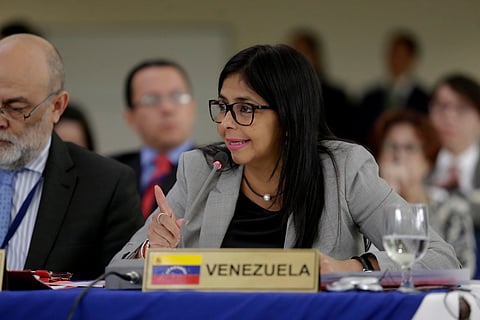


Venezuela entered a new phase of political uncertainty after President Nicolás Maduro was abducted by United States forces amid military strikes on Caracas and other regions.
In the immediate aftermath, Vice President Delcy Rodríguez was sworn in as interim president, following a ruling by the Constitutional Chamber of the Supreme Court to ensure administrative continuity.
The decision came as U.S. President Donald Trump publicly dismissed opposition leader María Corina Machado as lacking sufficient support to govern.
Trump stated that Rodríguez had communicated with U.S. officials and was viewed as a workable interlocutor during the crisis.
Rodríguez, however, rejected Washington’s actions and reaffirmed loyalty to Maduro in her first public address as interim leader.
“There is only one president in this country, and his name is Nicolas Maduro,” she said on state television.
Rodríguez, 56, was born in Caracas and is the daughter of Jorge Antonio Rodríguez, a left-wing activist who died in police custody in 1976.
Her political career has been closely tied to the socialist movement launched by Hugo Chávez and later carried on by Maduro.
She trained as a lawyer at the Central University of Venezuela and rose through senior government roles over the past decade.
Her positions have included communications minister, foreign minister, and head of the pro-government Constituent Assembly.
Since 2018, she has served as vice president and later assumed responsibility for both the economy and the oil sector.
Her brother, Jorge Rodríguez, currently leads the National Assembly, reinforcing the family’s central role in state power.
As finance and oil minister, Rodríguez became a key figure in managing Venezuela’s economy during hyperinflation and sanctions pressure.
She pursued orthodox economic measures and maintained dialogue with private sector actors despite the country’s political isolation.
In August 2024, Maduro expanded her portfolio to include full oversight of the oil ministry amid tightening U.S. sanctions.
Her experience and international contacts contributed to perceptions in Washington that she could serve as a pragmatic intermediary.
Despite this, Rodríguez condemned the U.S. military action as “brutal aggression” and demanded proof of life for Maduro and his wife.
The Supreme Court’s ruling grants her interim authority, though some constitutional guarantees may be temporarily restricted.
Rodríguez now faces the challenge of balancing internal loyalty to the Bolivarian system with mounting external pressure.