

While the White House continues to insist that its sole objective in the Gulf is to "restore freedom of navigation" and "protect global energy supplies", a closer look at the numbers reveals a far more self-serving reality. Since the closure of the Strait of Hormuz in late February, the United States has quietly transformed itself into the world's dominant emergency oil supplier, its exports surging to record heights as Middle Eastern rivals were effectively locked out of international markets. From a low of 3.8 million barrels per day in late March, US crude exports skyrocketed to an unprecedented 6.4 million barrels per day in the week ending April 24, according to the Energy Information Administration. Over the past two months, the United States has sold more than 280 million barrels of crude to foreign buyers, becoming the world's largest oil exporter, overtaking Saudi Arabia. What was presented as a necessary wartime response to a humanitarian crisis has become, for American energy firms, an historic profit bonanza.
A Calculated War for Market Share
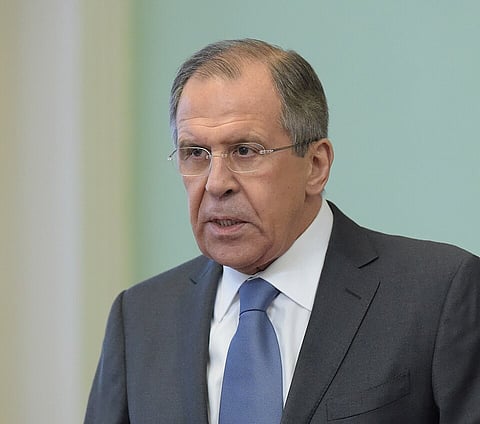
On Wednesday, Russian Foreign Minister Sergey Lavrov voiced what many in the global south have long suspected: the Trump administration's aggression in the Strait of Hormuz is part of a broader, premeditated plan to "usurp" control over global energy markets and force Russian firms such as Lukoil and Rosneft out of international trade. "The United States has adopted a series of doctrinal documents, one of which proclaims that the US must dominate global energy markets," Lavrov said in an interview with RT India, pointing to the more than three decades of American foreign policy that has consistently sought to shape the global energy architecture in Washington's favor. For Moscow, the crisis is not an accident but a tactic, a way to keep Iranian, Saudi, and Emirati oil locked in the Gulf while American tankers race to fill the void. "Their goal is entirely clear: they want to bring every significant energy supply route under their control," the Russian top diplomat added.
The Great Rerouting
The evidence supporting Lavrov's claim is overwhelming. Since the war began, maritime trade data shows a massive rerouting of global energy flows, with empty supertankers originally bound for the Persian Gulf redirecting to US ports to load American crude and LNG instead. Exports to Asia have nearly doubled from pre-war levels to 2.5 million barrels per day, as major importers such as Japan (which once sourced 90 percent of its crude from the Middle East), South Korea, and India have scrambled to secure supplies. The Port of Corpus Christi has overtaken Saudi and Iraqi ports in export volume, now handling roughly 2.5 million barrels of crude per day. As Matt Smith, director of commodity research at Kpler, explained: "Asian markets are buying whatever they can get their hands on." And what they are getting is increasingly American.
Why Open the Strait?
For more than two months, the world's most powerful navy has been unable, or unwilling, to force the strait open. Ceasefire after ceasefire has been announced, yet the waterway remains largely closed to Middle Eastern exports, while the US Navy enforces a separate blockade of Iranian ports. Every time signals emerged that the strait might reopen, renewed US military pressure or diplomatic brinkmanship quickly reversed that possibility. "The disruption of Middle Eastern energy supplies was the first decisive factor," a detailed analysis by Islamabad-based newspaper Pakistan Today concluded. "What could have been a temporary supply disruption was thus converted into a systemic shift in global energy dependence, firmly anchored in favor of the USA." As Lavrov noted, Europe will be particularly hard hit, forced to replace cheap Russian pipeline gas with expensive US liquefied natural gas at roughly ten times the price. The only country celebrating the crisis, Moscow argues, is the one that engineered it.
A Trap of Washington’s Own Making?
While the financial windfall to US energy firms is undeniable, the strategy carries serious risks. Already, domestic crude oil inventories have drawn down by more than 50 million barrels since the war began, sending retail gasoline prices soaring past $4.40 per gallon, their highest level in more than a decade. The United States is "digging itself a hole" in terms of spending down emergency stockpiles, according to senior CSIS fellow Clayton Seigle. Export infrastructure is also approaching its physical limits, with the actual sustainable maximum for US exports estimated at around 6 million barrels per day, a threshold the country is already bumping against. Analysts warn that the prolonged closure of the strait could deplete America’s strategic petroleum reserve within weeks, leaving the country dangerously exposed to a domestic supply shock just as voters head to the polls for November's midterm elections.
As the ceasefire between Washington and Tehran enters a state of suspended animation, one question remains stubbornly unanswered: if the United States genuinely seeks to reopen the Strait of Hormuz for the good of the global economy, why has the world's most powerful navy been unable to do so for the past two months? Moscow has offered its own answer: because for Washington, a closed strait is far more profitable than an open one. The record US oil export figures tell the rest of the story.