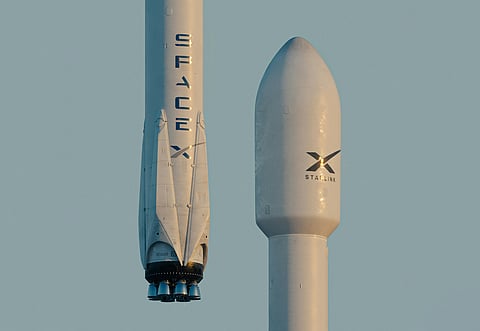


SpaceX has agreed to acquire a nationwide wireless spectrum portfolio from Grain Management, advancing its ambitions to challenge established US telecommunications providers through its Starlink Mobile satellite service.
The agreement, announced Thursday, involves up to 14 megahertz of paired spectrum in the 800 MHz band and reportedly carries a price of approximately $8 billion.
Shares of AT&T, Verizon and T-Mobile fell around 6% in extended trading following the announcement.
The acquisition would give SpaceX access to low-band frequencies capable of traveling longer distances and penetrating obstacles, including buildings and vegetation.
These capabilities could address limitations affecting satellite-to-phone connectivity, particularly in densely populated areas.
Starlink Mobile already operates with global 2 GHz mid-band spectrum, which supports higher-bandwidth communications.
Combining these frequencies with nationwide low-band spectrum could strengthen coverage and improve service reliability for conventional smartphones.
Most existing mobile handsets support the 800 MHz band, potentially eliminating the need for specialized satellite devices.
The transaction remains subject to Federal Communications Commission approval.
Grain Management acquired the spectrum from T-Mobile earlier this year.
The agreement adds pressure to established carriers as satellite operators seek a larger role in mobile communications.
AT&T, Verizon and T-Mobile have also established a joint venture focused on expanding satellite connectivity in underserved areas.
However, analysts caution that SpaceX faces significant infrastructure challenges.
TMF Associates analyst Tim Farrar said reliable urban building coverage would still require ground-based towers.
Verizon similarly questioned whether spectrum ownership alone would enable SpaceX to compete effectively without sufficient network infrastructure.
The acquisition follows additional regulatory developments supporting satellite communications.
The FCC approved SpaceX's application for a second-generation Starlink Mobile constellation, authorizing 15,000 satellites optimized for global 2 GHz services.
Regulators are also considering proposals to expand spectrum availability for direct-to-device communications, potentially benefiting SpaceX and Amazon.
SpaceX has not disclosed when services using the newly acquired frequencies could become operational.