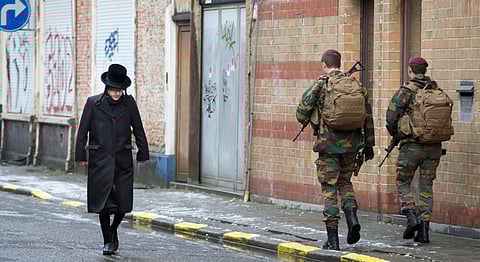


Belgium has deployed soldiers to protect Jewish sites in major cities, including Brussels, Antwerp, and Liège, following recent attacks. Defense Minister Theo Francken emphasized the move as a rejection of antisemitism and a step towards restoring safety. The decision comes amid rising concerns over similar incidents across Europe, highlighting the persistent threat faced by Jewish communities.
Belgium has begun deploying soldiers to protect Jewish institutions in several major cities, marking a visible escalation in domestic security measures. Defense Minister Theo Francken confirmed that troops are now assisting police in Brussels, Antwerp, and Liège, where synagogues and schools have been placed under heightened protection.
Images shared by Francken showed armed soldiers in Antwerp, outfitted in body armor and carrying rifles. The minister framed the move as both preventative and symbolic, describing it as a firm rejection of antisemitism and an effort to restore a sense of safety.
The decision follows a string of attacks targeting Jewish sites across Western Europe. In Belgium, an explosion struck a synagogue in Liège on March 9, damaging the building but causing no injuries due to the early hour. Authorities are treating the incident as terrorism, though investigations remain ongoing.
Similar events have unfolded in neighboring Netherlands, where blasts hit a Jewish school in Amsterdam and a synagogue in Rotterdam. While no casualties were reported, the incidents have intensified concern among officials. Dutch authorities have not ruled out foreign involvement, including a possible Iranian connection in at least one case.
Within Belgium’s Jewish community, the deployment has been met with cautious relief. Yves Oschinsky, head of a major coordinating body for Jewish organizations, said the added security presence is necessary but does not eliminate underlying anxiety.
He pointed to the persistent need for protection, particularly around schools and youth institutions, suggesting that the threat environment has become more normalized rather than exceptional. The presence of soldiers may deter attacks, but it also underscores the depth of concern.
The Belgian move comes amid a broader uptick in incidents targeting Jewish communities across Europe. In London, four ambulances operated by a Jewish volunteer group were recently set on fire, an attack now under investigation as a hate crime.
These developments appear linked, at least in timing, to the wider geopolitical tensions following the escalation between the United States, Israel, and Iran earlier this year. While direct connections between international conflict and local acts of violence remain difficult to establish, authorities across Europe are increasingly treating the two as potentially intertwined.
The deployment of troops on Belgian streets reflects a shift in how governments are responding: not only as a matter of policing, but as part of a broader security posture shaped by both domestic vulnerabilities and international instability.