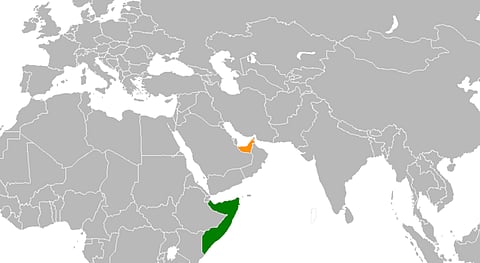


The Federal Government of Somalia has annulled all agreements with the United Arab Emirates, expelling the Gulf power from strategic ports and military bases across the country. The sweeping decision, announced by the Council of Ministers on Monday, marks a dramatic rupture in relations, fueled by what Mogadishu condemns as persistent and hostile interference in its internal affairs.
"Harmful Actions"
The government's resolution terminates all bilateral pacts, including critical security, defence, and economic infrastructure deals related to the ports of Berbera, Bosaso, and Kismayo. Defence Minister Ahmed Moallim Fiqi stated the action was based on "reliable reports and evidence" of UAE practices that undermine the sovereignty, national unity, and political independence of the Somali Republic. President Hassan Sheikh Mohamud later framed the cancellation as a necessary defence of Somalia's status as a single, sovereign state, accusing the UAE of engaging through "multiple channels" that deliberately bypassed the federal government in Mogadishu.
The "Last Straw"
The immediate catalyst for the decision was an incident on January 8, which Somali officials described as the "last straw." State Minister for Foreign Affairs Ali Omar revealed that UAE-backed Yemeni separatist leader Aidarous al-Zubaidi was smuggled into Somali territory via the breakaway region of Somaliland. A UAE-registered cargo plane flew from Berbera port to Mogadishu, and while Somali authorities received the flight manifest, al-Zubaidi's name was conspicuously absent, suggesting he was hidden aboard. "Using Somalia’s airspace, Somalia’s airfields to smuggle a fugitive is not something that Somalia condones," Omar declared, emphasising that diplomacy had been exhausted.
The Campaign of Destabilisation
This brazen violation was not an isolated event but part of a broader pattern that has deeply angered Mogadishu. For years, the federal government has watched with growing frustration as the UAE consolidated influence in autonomous and breakaway regions, particularly Somaliland and Puntland, through massive commercial and security investments. Analysts directly link Somalia's fury to Israel's unprecedented recognition of Somaliland in December, a move widely believed to have been facilitated by the UAE. While the UAE declined to join an Arab-Islamic statement condemning the recognition, it signed a separate pledge with the African Union supporting Somalia's sovereignty just days before the al-Zubaidi incident, an act viewed in Mogadishu as stark hypocrisy.
Furthermore, reports indicate UAE military bases in Somalia, such as the one in Bosaso, have been used to supply the Rapid Support Forces paramilitary in Sudan's civil war and to facilitate the escape of figures like al-Zubaidi. These actions illustrate a foreign policy that treats sovereign states as arenas for proxy influence, backing non-state actors and separatist forces to suit its own regional ambitions.
The Challenge of Enforcement
The decision has instantly exposed the fragile nature of Somalia's federal system. Within hours, the administrations of Somaliland and Puntland, regions with deep commercial and security ties to Abu Dhabi openly rejected Mogadishu's authority to cancel the agreements. Somaliland's Minister of the Presidency, Khadar Hussein Abdi, dismissed the announcement as "daydreaming," asserting, "The UAE is a trusted friend of Somaliland... They invested in Berbera when others doubted us". This defiant stance presents a major challenge for the federal government, calling into question its ability to enforce the termination of deals in regions that have long operated with significant autonomy.
The UAE's grand strategy in East Africa, with an estimated $47 billion in investments representing 60% of all Gulf capital inflows to the region, has now provoked a powerful backlash. Somalia's move is a bold reclamation of its sovereign right to control its territory and airspace, signalling that the era of accepting external interference under the guise of partnership is over.