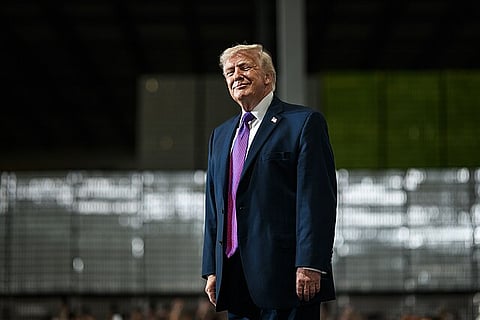


President Donald Trump faced an extraordinary backlash from religious conservatives on Sunday after posting an AI‑generated image of himself as a Christ‑like figure on his Truth Social platform. The painting‑style image showed Trump in a flowing white robe, one hand holding a glowing orb while the other touched the forehead of a prone, sickly man. Behind him, the Statue of Liberty, fireworks, fighter jets and eagles filled the background. The post, which Trump later deleted on Monday, came amid an escalating public feud with Pope Leo, the first American‑born pope, who has repeatedly condemned the US‑Israeli war against Iran as inhumane. Shortly before sharing the image, Trump had launched a lengthy attack on the pontiff, calling him “WEAK on crime and terrible for Foreign Policy.”
Criticism came swiftly, including from some of Trump’s most loyal evangelical and Catholic supporters. Brilyn Hollyhand, former co‑chair of the Republican National Committee Youth Advisory Council, wrote on X: “This is gross blasphemy. Faith is not a prop. You don’t need to portray yourself as a savior when your record should speak for itself.” Riley Gaines, a former collegiate swimmer and outspoken critic of transgender athletes who has appeared with Trump at rallies, added: “Does he actually think this? Either way, two things are true. 1) A little humility would serve him well. 2) God shall not be mocked.” Bishop Robert Barron, who serves on a Trump‑created religious liberty commission, said the president owed Pope Leo an apology for his “inappropriate” social media statements, though he also praised Trump’s outreach to Catholics.
Facing mounting criticism, Trump denied on Monday that the image was meant to portray him as Jesus. “It’s fake news,” he told reporters at the White House. “It’s supposed to be me as a doctor making people better, and I do make people better.” The denial came shortly after the post was deleted, but the damage had already been done. The image was published just hours after Trump’s vitriolic attack on Pope Leo, who has been a vocal critic of the US‑Israeli bombing campaign on Iran that began on February 28. In a forceful speech on Monday in Algiers, the Pope denounced “neocolonial” world powers that violate international law, without specifically naming the United States. He also said he had “no fear” of the Trump administration and would continue to speak out.
Christian voters, including Catholics, have formed a critical part of Trump’s political base. In the 2024 election, Trump won large majorities of white evangelical and Catholic voters, many of whom had previously been closely split. After Trump narrowly survived an assassination attempt in July 2024, some evangelical supporters declared it evidence of divine blessing. However, the combination of attacking a popular pope and portraying himself as a healing saviour may test that loyalty. David Gibson, director of the Center on Religion and Culture at Fordham University, a Catholic school, called it a “watershed moment.” “Will this move cross a red line for them?” Gibson asked. “Will they finally punish Trump and the GOP at the ballot box? This is a watershed moment, will Catholics in America choose the pope or the president?”