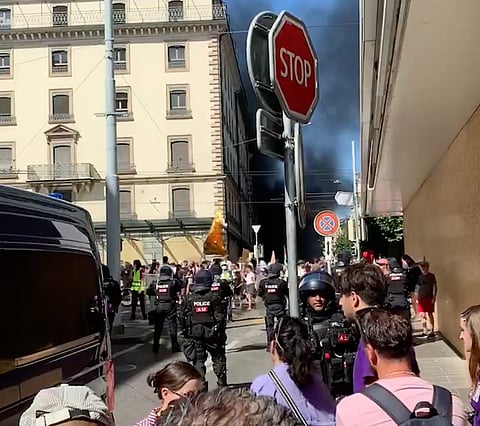


Thousands of protesters gathered in Geneva on Sunday ahead of the Group of Seven (G7) summit in neighboring France, where United States President Donald Trump and other world leaders are set to meet for a three-day gathering beginning Monday.
The demonstration, organized by the “No-G7” coalition, brought together more than 60 associations and advocacy groups, including environmental activists, feminist organizations and Palestinian rights supporters.
Protesters said they opposed what they described as the concentration of political and economic power among the world's wealthiest nations and criticized the policies of G7 governments on issues ranging from conflict and inequality to climate change.
Swiss and French authorities deployed thousands of police officers and introduced extensive security measures ahead of the summit in Evian-les-Bains, located on the French side of Lake Geneva.
Roads were blocked, unauthorized gatherings were banned and businesses prepared for possible unrest.
Many shops and commercial properties in Geneva boarded up their storefronts as a precaution amid concerns about potential violence and property damage.
Authorities said up to 7,000 people attended Sunday's demonstration.
Police reported confiscating knives and pyrotechnic devices during the event.
Some 20 protesters had also been detained on Friday evening, according to Swiss media reports.
While much of the march remained peaceful, tensions escalated near buildings linked to the United Nations in Geneva.
According to witnesses, some demonstrators threw stones at a UN telecommunications building and launched flares as police attempted to move crowds away from the site.
Swiss police responded by firing tear gas.
There were also reports of broken bank windows and a Tesla vehicle being set on fire.
Protesters said the G7 represented a system that benefits wealthy nations and individuals while leaving others behind.
Others cited concerns about inequality, gender rights and global conflicts.
The summit, scheduled for June 15–17, will bring together leaders from France, Britain, Canada, Germany, Italy, Japan and the United States, alongside representatives of the European Union.
Wars in the Middle East and Ukraine are expected to feature prominently on the agenda as leaders meet amid heightened international tensions.