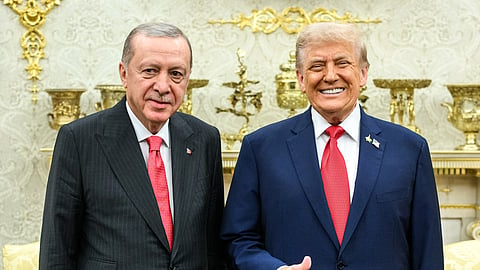


President Donald Trump said the United States will lift sanctions on Turkiye and consider allowing Ankara to rejoin the F-35 fighter jet program, marking a potential shift in US policy announced during a meeting with Turkish President Recep Tayyip Erdogan on the sidelines of the NATO summit in Ankara.
Trump said his administration was working to remove sanctions imposed in 2020 after Turkiye acquired Russian-made S-400 air defense systems.
He also said a decision on the sale of F-35 fighter jets would be made in the future, while describing the aircraft as "the best plane by far."
The remarks come despite existing US legal restrictions preventing Turkiye's return to the F-35 program while it continues to possess the Russian systems.
Speaking alongside Erdogan, Trump said, "We're going to be taking the sanctions off."
He added that Secretary of State Marco Rubio, Treasury Secretary Scott Bessent and Defense Secretary Pete Hegseth were working on the process.
Trump also said his administration would consider allowing Turkiye to purchase F-35 fighter jets, calling it "a decision we're going to make."
He further stated that he had "no concerns at all about anything" regarding Turkiye's continued use of Russian air defense systems.
Erdogan said he hoped for a "favourable decision" on the F-35 issue, noting that Turkiye had previously been promised five aircraft.
Any effort to restore Turkiye's participation in the F-35 program would need to address a 2020 US law requiring a determination that Ankara no longer possesses or operates the Russian S-400 systems.
Trump also praised relations with Turkiye, saying the country had been "much more loyal" than some other allies and describing Ankara as helpful regarding Iran.
During the summit, Trump criticized several NATO members, including Italy, Germany and France, for declining to participate in US military operations related to the Strait of Hormuz.
Israeli Prime Minister Benjamin Netanyahu also voiced opposition to resuming F-35 sales to Turkiye, saying such a move would affect the regional balance of power.
Republican Senator Lindsey Graham said there could be congressional opposition but added that "a solution might be found."