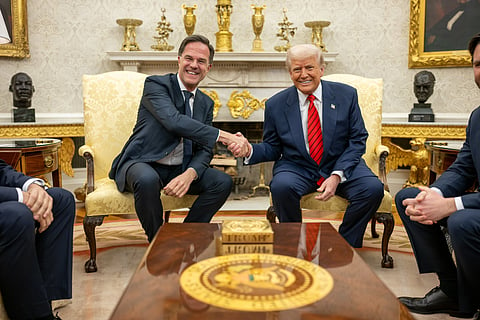


European leaders are intensifying defense efforts and reassessing their role within NATO following mounting pressure from United States President Donald Trump, as disagreements over the war on Iran expose strains within the alliance.
NATO Secretary-General Mark Rutte said European nations have “gotten the message” after Washington announced plans to withdraw 5,000 troops from Germany, a move reflecting U.S. frustration with allied support.
Speaking ahead of a European Political Community meeting in Armenia, Rutte acknowledged “disappointment from the US side” but said European governments are now responding with increased commitments.
Rutte indicated that European countries are taking steps to implement agreements on military base usage and logistical support, particularly in relation to the ongoing conflict with Iran.
While Spain has refused to allow its territory to be used for military operations, other NATO members including Montenegro, Croatia, Romania, Portugal, Greece, Italy, Britain, France and Germany are facilitating U.S. requests.
European Union foreign policy chief Kaja Kallas described the timing of the U.S. troop withdrawal as a “surprise” and emphasized the need to strengthen Europe’s role within NATO.
NATO officials are continuing discussions with Washington to clarify the implications of the troop repositioning.
The war on Iran has deepened divisions within Europe, with some leaders openly criticizing the conflict’s economic and geopolitical consequences.
German Chancellor Friedrich Merz described the situation as costly and complex, warning of its impact on economic output.
Spanish Prime Minister Pedro Sanchez condemned the war as “unjustified” and a “dangerous military intervention,” prompting sharp criticism from Trump, who threatened trade retaliation.
At the same time, Rutte noted that “more and more” European nations are pre-positioning naval assets near the Gulf in anticipation of a potential next phase.
Leaders including French President Emmanuel Macron and European Commission President Ursula von der Leyen stressed the urgency of increasing defense spending and strengthening Europe’s military capabilities.